Written by Field Name
Report Date
5 min read

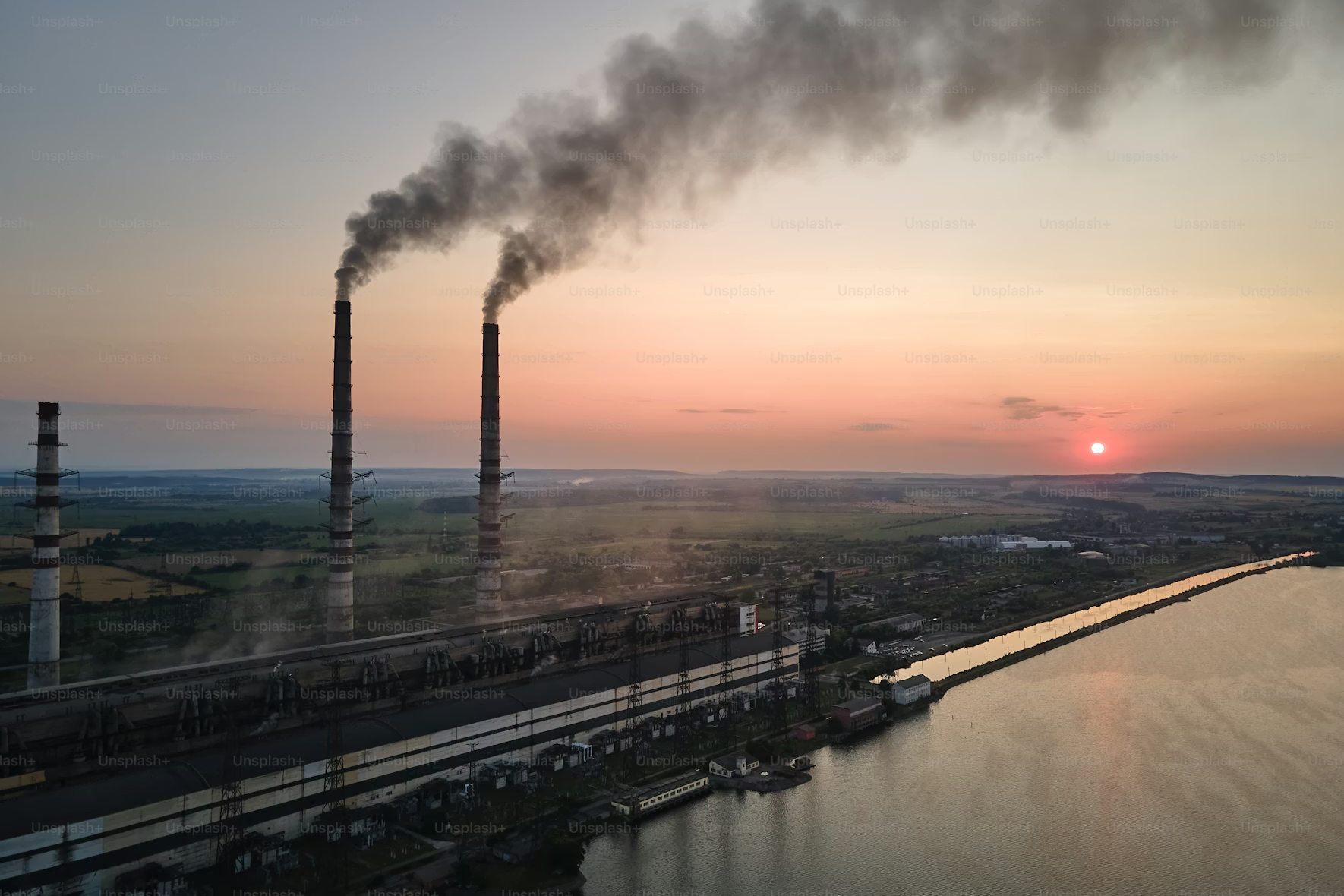
Australia is entering a new phase of mandatory climate and carbon emissions reporting. From 2025 and throughout 2026, many organisations will be legally required to disclose climate related financial information, including greenhouse gas emissions, as part of their annual reporting obligations.
For boards, executives and finance leaders, this represents a fundamental shift. Climate disclosures are now treated as financial disclosures, subject to director sign off, audit and regulatory oversight. Organisations that prepare early will be better positioned to manage risk, meet stakeholder expectations and avoid last minute compliance pressure.
This article outlines Australia’s mandatory climate reporting requirements, who must report, what must be disclosed, key deadlines, Scope 1–3 emissions obligations, risks of non-compliance, and practical steps to prepare.
Mandatory climate reporting is a legal requirement introduced through amendments to the Corporations Act 2001. It requires certain entities to prepare a Sustainability Report alongside their annual financial statements, disclosing climate related risks, opportunities and emissions.
The reporting framework is established under the Australian Sustainability Reporting Standards (ASRS), issued by the Australian Accounting Standards Board. The primary mandatory standard is AASB S2 Climate related Disclosures, which is closely aligned with international standards developed by the International Sustainability Standards Board.
The intent of the regime is clear: climate risk is now considered a financial risk, and organisations must explain how it is identified, governed and managed over time.
Mandatory climate reporting applies to entities that already prepare financial reports under Chapter 2M of the Corporations Act. This includes many listed and large private companies, financial institutions, superannuation entities and managed investment schemes.
Entities are phased in across three reporting groups, based on size and reporting profile.
Entities that meet at least two of the following:
Group 1 also includes entities registered under the National Greenhouse and Energy Reporting (NGER) scheme. These organisations are required to report for financial years commencing on or after 1 January 2025.
Entities that meet at least two of the following:
Group 2 entities commence reporting from 1 July 2026.
Entities that meet at least two of the following:
Group 3 entities commence reporting from 1 July 2027.
While some organisations may not be legally in scope initially, many will still be indirectly affected. Larger customers, investors and lenders will increasingly require emissions data particularly Scope 3 emissions as part of their own mandatory climate reporting obligations.
In scope entities must prepare a Sustainability Report that forms part of their annual statutory reporting. This report must be approved by directors, lodged with ASIC and made publicly available.
The Sustainability Report must include climate statements covering the following areas:
How the board and management oversee climate related risks and opportunities, including roles, responsibilities and accountability mechanisms.
How climate related risks and opportunities affect the organisation’s strategy, business model and financial planning across short-, medium- and long-term horizons.
The processes used to identify, assess and manage climate-related risks, and how these processes are integrated into broader enterprise risk management frameworks.
The metrics used to assess climate performance and progress against targets, including greenhouse gas emissions.
An assessment of how resilient the organisation’s strategy and business model are under different climate scenarios, including those aligned to temperature outcomes specified in Australian legislation.
These disclosures are treated as financial disclosures and are subject to audit, regulatory scrutiny and liability provisions under the Corporations Act.
Greenhouse gas emissions reporting is a core component of mandatory climate reporting in Australia.
Direct emissions from sources owned or controlled by the organisation, such as fuel combustion in company vehicles, onsite generators or industrial processes.
Indirect emissions from the generation of purchased electricity, heating or cooling consumed by the organisation.
All other indirect emissions that occur across the organisation’s value chain, both upstream and downstream. This includes emissions from suppliers, logistics, business travel, use of sold products and waste.
For many organisations, Scope 3 emissions represent the largest share of total emissions and are also the most complex to measure due to reliance on third-party data.
Scope 3 reporting is phased in under ASRS:
Limited transitional relief applies; however, entities must still disclose how they are managing Scope 3 emissions and improving data quality over time.
The implementation of mandatory climate reporting occurs over several years:
Assurance requirements also increase progressively, moving from limited assurance toward more comprehensive audit expectations.
Sustainability Reports must be lodged with ASIC and made available to members, including presentation at AGMs where applicable.
Organisations preparing for mandatory climate reporting commonly face challenges such as:
These challenges are most acute for Scope 3 emissions and climate scenario analysis, which require structured data, consistent assumptions and robust documentation.
Climate disclosures are subject to the same liability framework as financial reporting. Risks include:
While limited liability relief applies during the initial transition period, this protection is temporary and does not remove the need for defensible processes and evidence.
Effective preparation typically includes the following steps:
Fair Supply supports organisations navigating mandatory climate and emissions reporting through a combination of regulatory expertise and our purpose built technology.
Our carbon emissions accounting platform enables organisations to measure and manage Scope 1, 2 and 3 emissions, engage suppliers, maintain traceability from source data to disclosure, and align reporting with ASRS and audit requirements.
Our advisory team of carbon emissions consultants works alongside finance, risk and sustainability functions to design governance frameworks, close data gaps and support audit-ready Sustainability Reports.
Mandatory climate reporting in Australia represents a significant change in corporate reporting expectations. Climate and emissions disclosures are now embedded within financial reporting frameworks and subject to regulatory oversight.
Organisations that act early will be better positioned to manage risk, meet stakeholder expectations and navigate the transition with confidence. With appropriate systems, governance and support, compliance can be achieved in a structured and efficient manner.