
ESG Software for Education Providers
Fair Supply enables education institutions to understand their entire supply chain, quantify ESG risks across academic and operational procurement, and lead the sector in transparency, integrity and responsible stewardship of public and private resources.
.avif)
Universities, schools and education networks around the world rely on Fair Supply to strengthen governance, procurement assurance and ESG performance.






Turn ESG obligations into a strategic advantage
Forward-thinking education providers are moving beyond compliance-driven reporting and using ESG insights to strengthen governance, safeguard institutional reputation and improve financial accountability across complex supply chains. By embedding ESG into procurement and operational decision-making, institutions can reduce exposure to ethical and regulatory risk while supporting long-term sustainability
With Fair Supply, ESG becomes more than risk management. It becomes a foundation for ethical procurement, campus resilience and community trust, supporting transparent decision-making for boards, regulators, students and funding bodies.
Stay ahead of regulation
Keep pace with evolving ESG frameworks, including ISSB, reporting standards and modern slavery legislation, and remain audit ready across all jurisdictions in which the institution procures goods and services.
Build trust with students, staff and stakeholders
Demonstrate a commitment to ethical and sustainable procurement through defensible, data-driven insights that support transparency for governing councils, accreditation bodies, government agencies and the broader community.
Uncover hidden risks in your supply chain
Identify suppliers and service providers with elevated ESG risks before they become liabilities. This includes facilities management, construction, IT systems, catering, uniforms, laboratory equipment, cleaning contractors and student service providers.
Manage multiple risk types, all in one platform

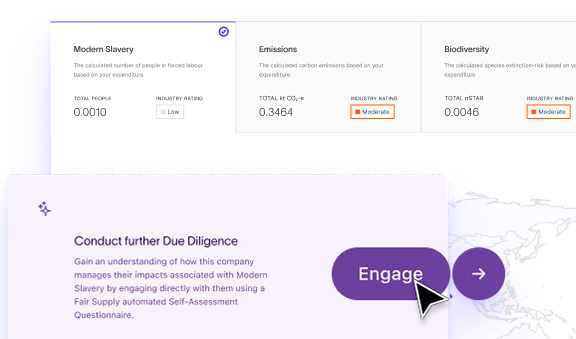
Modern Slavery
Understand human rights risks and stay aligned with current and emerging regulations in any region.

Carbon Emissions
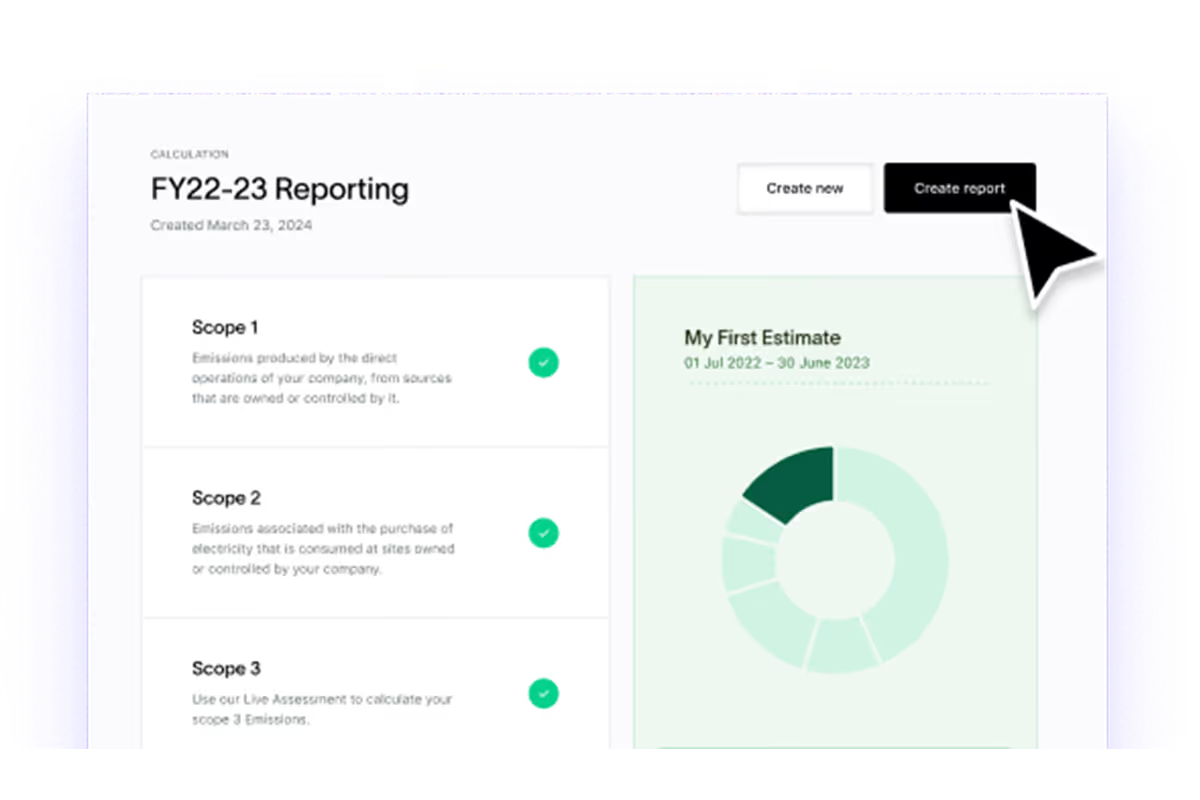
Model Scope 1, 2 and 3 emissions across your supply chain and produce fast disclosures and regulator-ready reports.

Biodiversity Impact
Measure environmental destruction throughout your supply chain and proactively reduce your impact to stay ahead of evolving regulations and customer concerns.

Global Trade Risk
Use our tariff calculator to understand the impact of global trade policy shifts on your supply chain costs.
Global Supply Chain Mapping
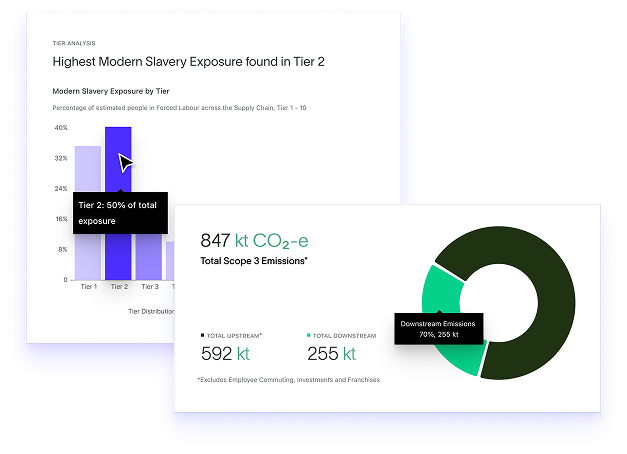
Visualise every tier of your education supply chain with high resolution data that highlights ESG risks across both academic and corporate services.Fair Supply uses proprietary modelling to trace exposure beyond direct suppliers and reveal indirect and deep-tier relationships that typically remain hidden in global education procurement ecosystems.
Engage Suppliers at Scale
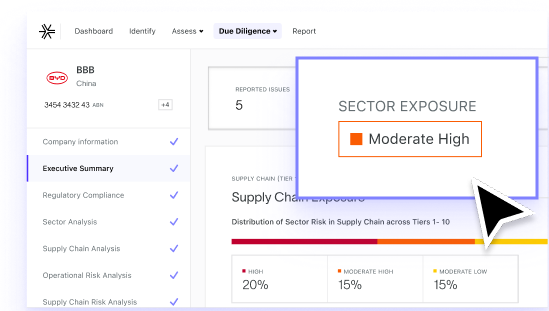
Centralise how you assess, engage, and document supplier ESG performance. Standardise SAQs, track responses, and maintain a clear, auditable record of activity.



Companies like yours are getting visibility into their risks
FAQs
Don't see what you're looking for?
Does Fair Supply offer consulting and advisory services?
Yes. Alongside our supply chain ESG intelligence platform, we provide specialist advisory across two core regulatory domains: modern slavery reporting consulting for organisations meeting their obligations under the Modern Slavery Act 2018 (Cth), and climate reporting consulting for entities preparing climate-related financial disclosures. Our team maintains current knowledge of IFRS S2 (ISSB), EU CSRD, AASB S2, NZ CS 1 and other emerging frameworks to ensure comprehensive compliance guidance. Engagements range from one-off statement and disclosure preparation through to ongoing advisory retainers, and can be combined with platform access under a single agreement.
Does Fair Supply cover Scope 1 and 2 emissions as well as Scope 3?
Yes. Alongside our Scope 3 value chain modelling, the platform supports Scope 1 and 2 emissions reporting — covering direct emissions from owned or controlled sources and indirect emissions from purchased electricity, steam, heating and cooling. This gives organisations a single consolidated view across all three scopes for AASB S2, IFRS S2, and GHG Protocol-aligned disclosure, with outputs that integrate with existing carbon accounting platforms where required.