Written by Field Name
Report Date
5 min read


The organisational response to modern slavery due diligence has matured considerably since the introduction of the Modern Slavery Act 2018 (Cth)
However, one common practice persists: sending the same questionnaire to every supplier in your register, regardless of risk. If your organisation is still doing this, you could be simultaneously over investing in low risk supplier relationships and under-investing where the exposure to forced labour risk is greatest.
This article sets out why blanket supplier engagement approaches fall short, and how a robust risk-tiered methodology works in practice.
A risk-based approach to supplier due diligence means directing the intensity of your resources and efforts in proportion to where risk to people is most significant. It requires organisations to assess risk against significance and proximity before allocating resources, in recognition that not all suppliers represent equal risk exposure.
Significance is assessed as a function of severity first, and then likelihood.
Alongside significance, prioritisation also depends on proximity, meaning where your organisation's responsibility and leverage are highest.
The OECD Due Diligence Guidance for Responsible Business Conduct is explicit on the importance of triaging risk. Enterprises should "identify general areas where the risk of adverse impacts is most significant and, based on this risk assessment, prioritise suppliers for due diligence."
The Commonwealth Modern Slavery Act 2018 Guidance for Reporting Entities (May 2023) operationalises this principle through four recognised risk dimensions: sector and industry, products and services, geography, and entity.
The UN Guiding Principles on Business and Human Rights, which is the foundational document from which both instruments draw, likewise frames due diligence as proportionate to the severity and likelihood of harm.
The appeal of a uniform questionnaire approach is that it is relatively straightforward to administer. Send the same form to every supplier, collect responses, and file them away. But In practice, this is not a sufficiently robust and defensible approach to due diligence.
The Commonwealth Guidance's four risk dimensions provide a practical framework for triage.
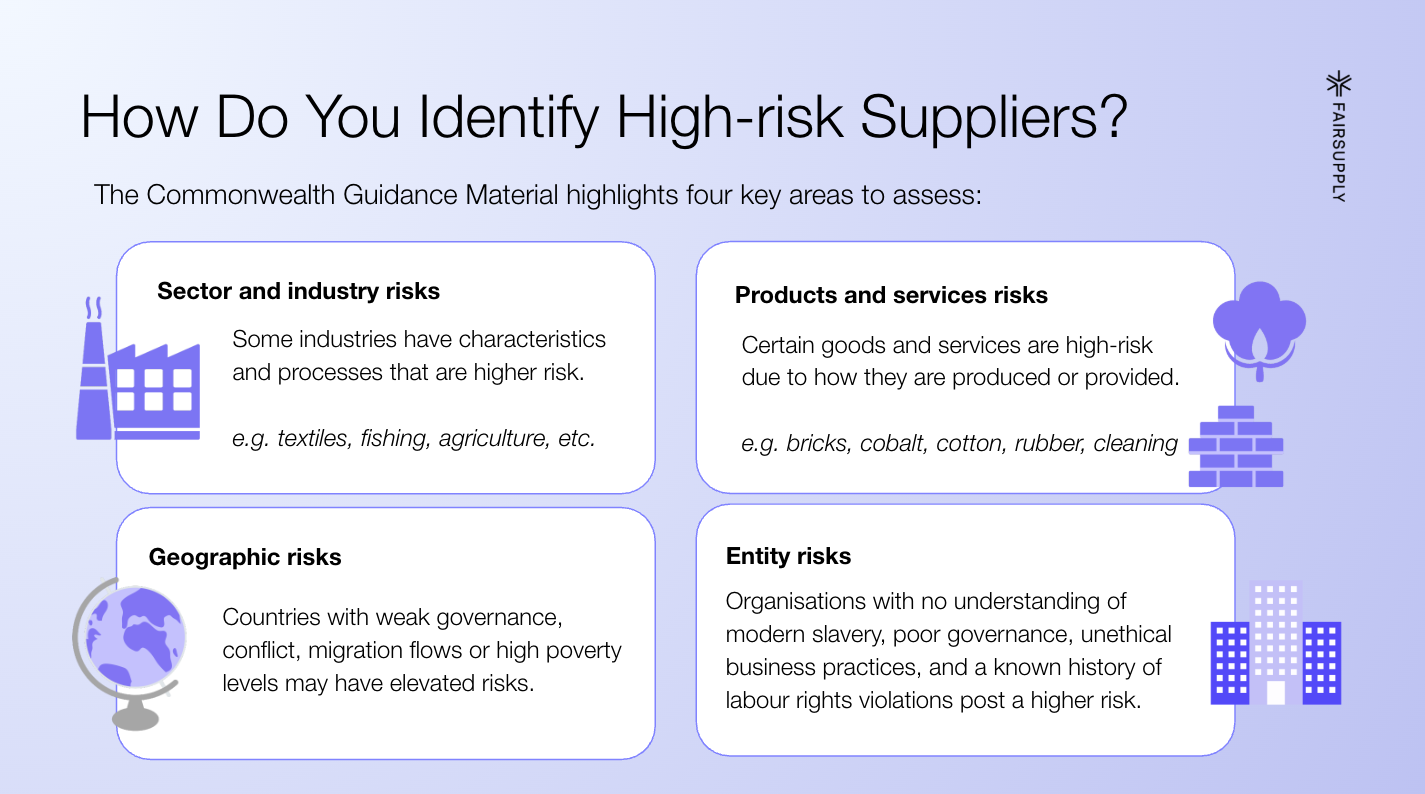
Once suppliers have been assessed across these four dimensions, they can be allocated to tiers that determine the nature and intensity of due diligence.
An often-overlooked dimension of a risk-tiered approach is calibrating the form of engagement to the supplier's size and sophistication, not just their risk profile.
Where the supplier is itself a reporting entity, such as a major bank, a national telco, a large logistics provider, the starting point should be a review of their published modern slavery statement. Under the Act, they are required to report on their own due diligence systems. Requesting that they complete your questionnaire before reviewing what they have already disclosed publicly signals a lack of rigour in your own process, and frequently produces responses that simply replicate their statement in a different format.
Where the supplier is small, low-sophistication, or operating in a high-risk sector, a heavyweight self-assessment questionnaire may produce responses that are aspirational rather than accurate, or may end up being beyond their capacity to complete. It’s rare that suppliers that do this act in bad faith, but because they themselves may lack the information and systems to answer with confidence. In these cases, direct engagement, such as a conversation, a site visit, or a structured interview, will generate more reliable intelligence than a written disclosure. The due diligence framework should accommodate both.
The most progressive and effective risk-tiered due diligence is embedded at every stage of the procurement lifecycle.
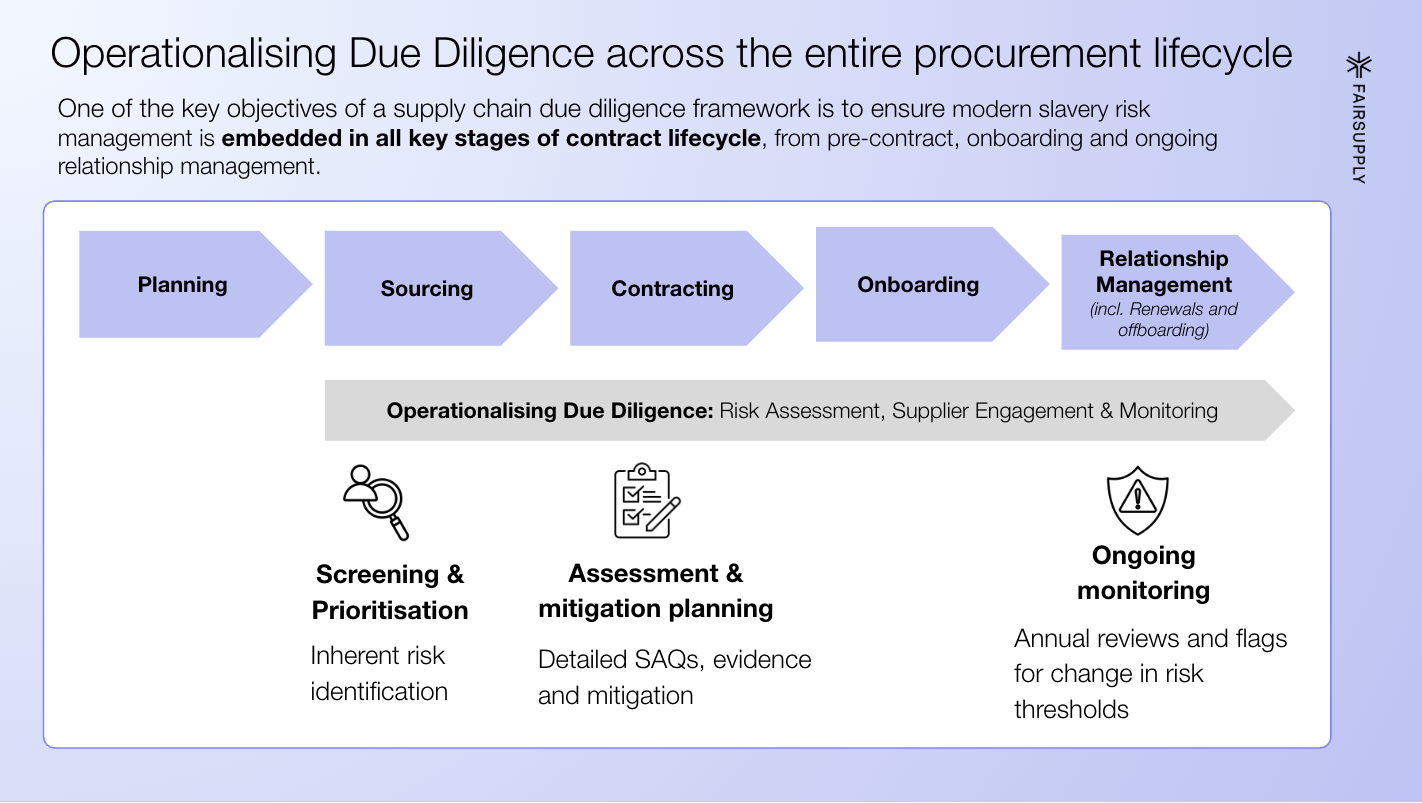
At the planning stage, category managers should identify the risk profile of the spend category before going to market. Draw on sector, product, and geographic risk indicators to inform the level of due diligence that will be required and the supplier characteristics that will be evaluated.
At the sourcing stage, due diligence requirements should be incorporated into tender documents and evaluated as part of supplier selection. For elevated-risk categories, this may mean requiring evidence of third-party certification or audit history as a prequalification condition.
At the contracting stage, modern slavery obligations should be reflected in contract terms. This may include clauses around audit rights, disclosure requirements, and remediation processes. Blanket termination rights are rarely appropriate; cooperative engagement and graduated consequences better reflect the guidance's emphasis on remediation over disengagement.
At onboarding, suppliers should complete a tiered assessment calibrated to their risk profile, with follow-up proportionate to the responses received.
During relationship management, monitoring should be ongoing and trigger-responsive. Changes in the supplier's ownership, geographies, subcontracting arrangements, media status, or sector classification may warrant reassessment between cycles.
Several errors appear consistently in how organisations implement supplier due diligence programmes. These include:
Ultimately, it comes down to proportionality. The best practice approach is a tiered one that takes into account the appropriate risk dimensions, is calibrated to supplier size and sophistication, and is proactively embedded across the procurement lifecycle.
The OECD Guidance, the Commonwealth Guidance, and the UN Guiding Principles all clearly state the importance of having a risk-based approach to modern slavery management. Reporting entities should ensure the methodology they have in place is genuinely proportionate, documented, and capable of generating genuinely useful insights that are needed to identify and address modern slavery risk where it is most likely to occur.
Operationalising a risk-based approach across hundreds or thousands of suppliers is a practical challenge most reporting entities face. Determining how to triage suppliers, and then manually managing response rates, maintaining audit trails, and producing reporting that satisfies board and investor scrutiny can very quickly be unscalable.
Fair Supply's modern slavery assessment platform supports organisations in streamlining tiered risk assessment and automates the sending, tracking and analyses of supplier responses. Fair Supply also provides advisory services for procurement and sustainability leaders on framework design, supplier engagement strategy, and the integration of modern slavery obligations into the procurement lifecycle.
If you are ready to move beyond a blanket questionnaire approach, talk to our team about building a risk-tiered due diligence programme that's proportionate, defensible, and built to scale.