
CLIMATE REPORTING SOFTWARE AND ADVISORY
Complete carbon reporting, without the complexity
Combining platform and expert guidance to deliver defensible reporting, from emissions measurement and climate strategy to final disclosure.




Built for every stage of climate reporting
Platform
- Full Scope 3 screening in days, not months.
- Automated classification, emissions factors and GHG categorisation.
- Trusted methodology, with independent limited assurance for defensibility.
Platform
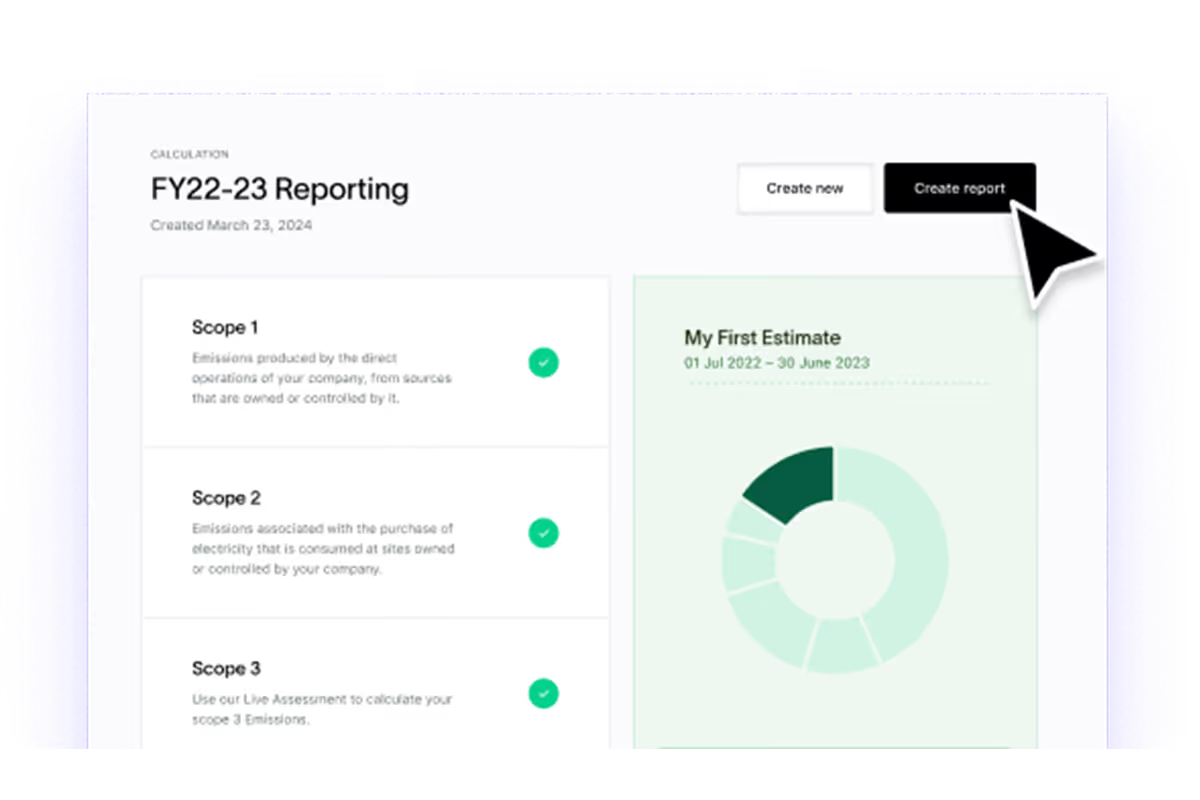
- Create a Scope 1 and 2 estimate in minutes.
- Refine data over time to build a complete, audit-ready inventory.
- Outputs are aligned to the GHG Protocol, ready to support ASRS and ISSB reporting.
Consulting services
Platform
End-to-End Emissions Compliance Software
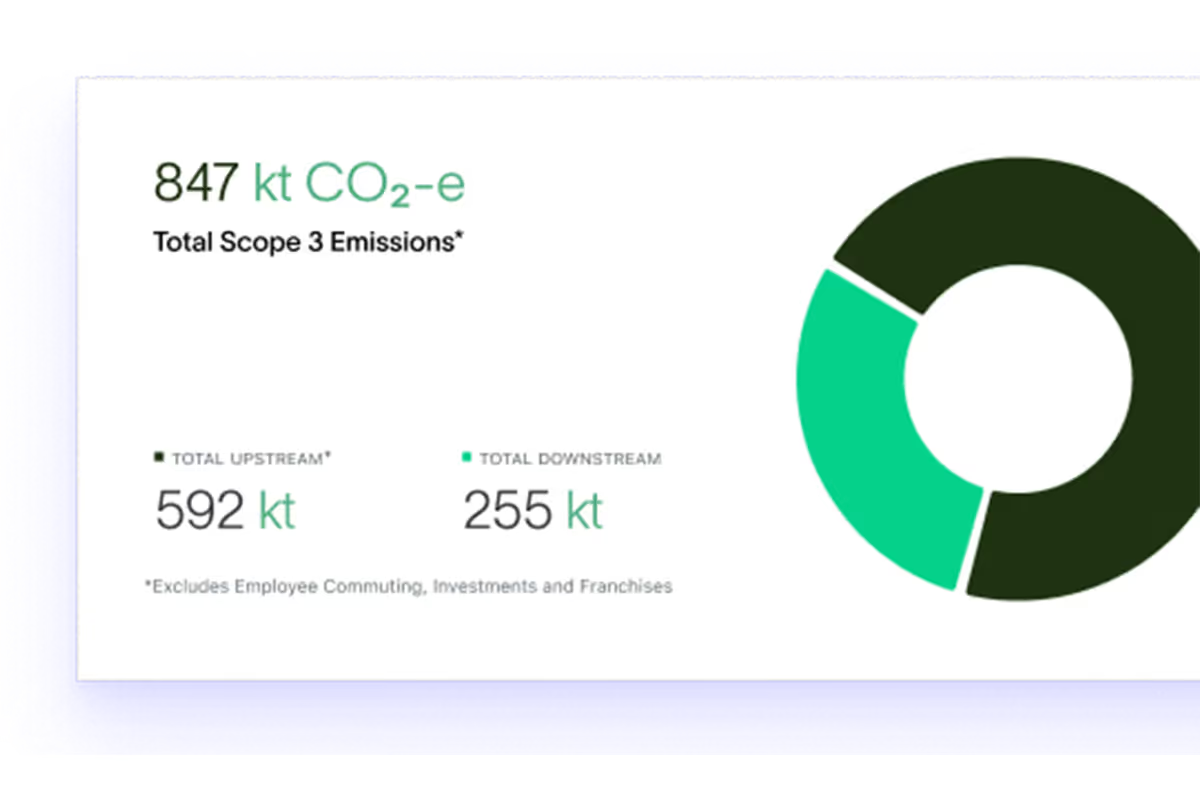
Make Climate Progress Measurable
Track Scope 1 and 2 emissions using audit-ready data, and model Scope 3 emissions based on supplier spend, geography, and industry. Turn raw data into measurable progress towards your company’s net zero and decarbonisation goals.
Build your inventory faster
Automatically apply verified emissions factors to your Scope 1 and 2 data inputs, and classify supplier spend against the GHG Protocol to screen Scope 3 categories without manual effort. Spend less time building your inventory and more time acting on it.
.png)
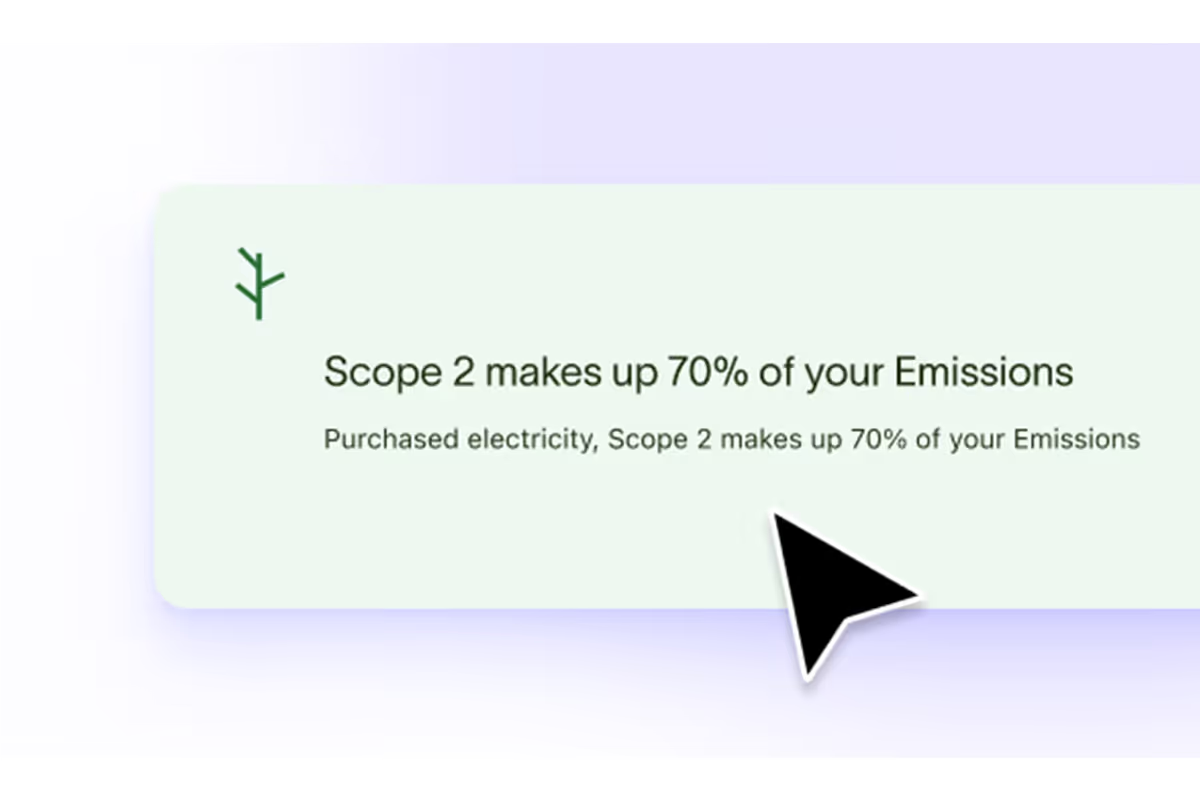
Visualise Risk and Opportunity
Spot emissions hotspots and maturity gaps with visual dashboards—segmented by category, region, or supplier. Prioritise where action will have the greatest impact on your decarbonisation strategy.
Stay Aligned and Audit-Ready
Build confidence with boards, investors, and auditors through audit-ready outputs. Fair Supply’s outputs tie into global climate frameworks including TCFD, IFRS S2 & 4, and CSRD—ready for disclosure at any time.
Heading 3
Lorem ipsum dolor sit amet, consectetur adipiscing elit, sed do eiusmod tempor incididunt ut labore et dolore magna aliqua. Ut enim ad minim veniam, quis nostrud exercitation ullamco laboris nisi ut aliquip ex ea commodo consequat. Duis aute irure dolor in reprehenderit in voluptate velit esse cillum dolore eu fugiat nulla pariatur.
Heading 3
Lorem ipsum dolor sit amet, consectetur adipiscing elit, sed do eiusmod tempor incididunt ut labore et dolore magna aliqua. Ut enim ad minim veniam, quis nostrud exercitation ullamco laboris nisi ut aliquip ex ea commodo consequat. Duis aute irure dolor in reprehenderit in voluptate velit esse cillum dolore eu fugiat nulla pariatur.
Companies like yours are getting visibility
Into the ESG risks hidden in their supply chain.


Learn with us
Our latest educational webinars and resources, created by experienced industry experts.


Carbon Emissions Reporting for Energy Companies: What You Need to Know
FAQs
Don't see what you're looking for?
Does Fair Supply cover Scope 1 and 2 emissions as well as Scope 3?
Yes. Alongside our Scope 3 value chain modelling, the platform supports Scope 1 and 2 emissions reporting — covering direct emissions from owned or controlled sources and indirect emissions from purchased electricity, steam, heating and cooling. This gives organisations a single consolidated view across all three scopes for AASB S2, IFRS S2, and GHG Protocol-aligned disclosure, with outputs that integrate with existing carbon accounting platforms where required.
How quickly can we generate our first emissions baseline with Fair Supply?
Most organisations can produce their first Scope 1 and 2 emissions estimate within minutes using Fair Supply's guided calculator. For Scope 3 emissions, you can generate a complete Scope 3 emissions report by category within weeks by simply uploading basic supplier spend data.
Our technology automatically classifies suppliers by industry and geography, applies unique emissions factors to each tier of the supply chain, and assigns each supplier to the correct GHG Protocol category without manual data collection.
Can Fair Supply handle Scope 3 emissions if we don't have supplier-specific data yet?
Yes. Fair Supply uses Environmentally Extended Input-Output (EEIO) modeling to estimate Scope 3 emissions based on supplier spend, sector, geography and economic activity across up to 10 tiers. This allows you to produce a defensible Scope 3 screening immediately, then refine data quality over time as you engage suppliers and collect primary data. It's the fastest way to move from zero visibility to a complete baseline.
How does Fair Supply ensure our emissions data will pass the audit?
Fair Supply provides an immutable audit trail that tracks every data input, calculation methodology and emissions factor used in your reporting. The platform's outputs are mapped to the GHG Protocol and aligned with frameworks like ASRS, ISSB, CDP and CSRD.
Fair Supply's Scope 3 methodologies have undergone independent limited assurance, giving auditors confidence in the defensibility of the approach without requiring you to validate methods from scratch each reporting cycle.
Does Fair Supply comply with Australia's mandatory climate reporting requirements under AASB S2?
Yes. Fair Supply's carbon emissions accounting software is purpose-built to support compliance with AASB S2 Climate-related Disclosures under the Australian Sustainability Reporting Standards.
The platform enables you to measure Scope 1, 2 and 3 emissions, maintain audit-ready documentation, and produce regulator-ready disclosures aligned to the four core pillars of governance, strategy, risk management, and metrics and targets required by ASRS.
What's the difference between Fair Supply's Scope 3 screening and a full Scope 3 inventory?
A Scope 3 screening uses automated EEIO modeling to rapidly assess emissions across your entire supplier base, identify hotspots, and prioritize where deeper engagement is needed. A full Scope 3 inventory involves collecting primary data from suppliers and applying activity-based calculations for each category.
Fair Supply supports both: start with automated screening to establish a defensible baseline quickly, then progressively refine material categories into a detailed inventory with supplier engagement and expert support.
How does Fair Supply handle emissions across multi-tier supply chains?
Fair Supply's EEIO analysis models emissions across up to 10 tiers of your supply chain, not just your direct suppliers. This is critical because emissions often accumulate deep in the value chain — across raw materials, component manufacturing and logistics providers.
The platform maps spend data to supplier location and industry, then calculates embodied emissions across multiple tiers to give you full visibility into where carbon risk actually sits in your extended supply chain.
Can we engage suppliers directly through Fair Supply to collect emissions data?
Yes. Fair Supply includes built-in supplier engagement tools that allow you to launch emissions-focused Self Assessment Questionnaires (SAQs), track supplier responses, benchmark supplier performance against peers, and update mitigation plans — without manually chasing suppliers.
This moves you from estimated EEIO data toward primary supplier-reported emissions data while maintaining workflow efficiency and audit traceability.
How does Fair Supply help us meet the phased Scope 3 reporting deadlines in Australia?
Under mandatory climate reporting in Australia, Scope 3 disclosure requirements are phased in: Group 1 entities must report Scope 3 from January 2026, Group 2 from July 2027, and Group 3 from July 2028.
Fair Supply's automated screening means you can establish a compliant Scope 3 baseline immediately rather than waiting months for manual data collection, giving you a critical head start on meeting your reporting obligations and avoiding last-minute compliance pressure.
What level of accuracy can we expect from Fair Supply's Scope 3 estimates?
Fair Supply's EEIO modeling provides industry-standard accuracy comparable to spend-based and average data methods recognized under the GHG Protocol. While EEIO estimates are less precise than supplier-specific primary data, they are defensible, auditable and accepted by regulators as an appropriate methodology for initial Scope 3 screening.
As you refine data quality through supplier engagement, Fair Supply supports hybrid approaches that combine EEIO with activity-based calculations for material categories to progressively improve accuracy.
Does Fair Supply integrate with our existing procurement or finance systems?
Fair Supply is designed to work with the tools you already manage. The platform accepts spend data from standard formats (CSV, Excel) exported from ERP, procurement or AP systems — there's no requirement to replace existing systems.
Once data is uploaded, Fair Supply automates classification, emissions factor assignment and GHG categorization, then produces outputs that feed directly into sustainability reports, ESG disclosures or climate risk assessments without disrupting current workflows.
How does Fair Supply compare to managing carbon accounting in spreadsheets?
Spreadsheets require manual supplier classification, manual research of emissions factors, manual GHG category assignment, and manual calculations repeated for every supplier across every reporting period. Fair Supply automates all of this at scale.
What would take months of manual work across thousands of suppliers happens in weeks with automated classification and audit-ready outputs. You also avoid version control issues, formula errors and the lack of traceability that make spreadsheet-based reporting difficult to audit and impossible to scale efficiently.
Can Fair Supply support climate scenario analysis and resilience disclosures required under ASRS?
Yes. Fair Supply provides the emissions data and supplier risk insights that underpin climate scenario analysis and resilience assessments required under AASB S2.
By identifying emissions hotspots by supplier, geography and industry, you can model exposure under different climate scenarios — physical risks, transition risks, carbon pricing — and assess the resilience of your supply chain and business model. Fair Supply's advisory team also supports organisations in structuring scenario analysis frameworks aligned to ASRS and TCFD disclosure expectations.
Does Fair Supply provide consulting support or is it just software?
Fair Supply combines technology with human expertise. While the platform automates the heavy lifting of supplier classification, emissions calculations and GHG categorization, our team of carbon accounting specialists provides hands-on consulting for the complex parts that software alone can't solve.
This includes designing bespoke methodologies for unusual emissions categories, advising on materiality assessments and boundary setting, supporting climate scenario analysis and resilience disclosures, preparing for auditor queries, and building internal capability across finance, sustainability and procurement teams.
This hybrid approach means you get the speed and scale of automation with the judgment and defensibility that comes from experienced advisors who understand both the technical requirements and the regulatory context.
What carbon accounting tools are included in Fair Supply?
Fair Supply provides both a Scope 1 and 2 Emissions Calculator and a Scope 3 Supply Chain Assessment using EEIO modeling.
Does Fair Supply support audit-ready Scope 1 and Scope 2 carbon reporting?
Yes. Fair Supply provides guided calculators to help organisations estimate and report their Scope 1 (direct) and Scope 2 (energy-related) emissions. The outputs align with leading frameworks like the GHG Protocol, CDP, IFRS S2, and ESRS, making them suitable for formal audits, disclosures, and internal climate targets.
How does Fair Supply calculate Scope 3 supply chain emissions for carbon reporting?
Fair Supply uses Environmentally Extended Input-Output (EEIO) analysis to model Scope 3 emissions based on supplier spend, sector, geography, and economic activity across up to 10 tiers.
Does Fair Supply offer consulting and advisory services?
Yes. Alongside our supply chain ESG intelligence platform, we provide specialist advisory across two core regulatory domains: modern slavery reporting consulting for organisations meeting their obligations under the Modern Slavery Act 2018 (Cth), and climate reporting consulting for entities preparing climate-related financial disclosures. Our team maintains current knowledge of IFRS S2 (ISSB), EU CSRD, AASB S2, NZ CS 1 and other emerging frameworks to ensure comprehensive compliance guidance. Engagements range from one-off statement and disclosure preparation through to ongoing advisory retainers, and can be combined with platform access under a single agreement.