
Scope 1 & 2 Emissions Reporting Software
Operational Emissions Data You Can Rely On
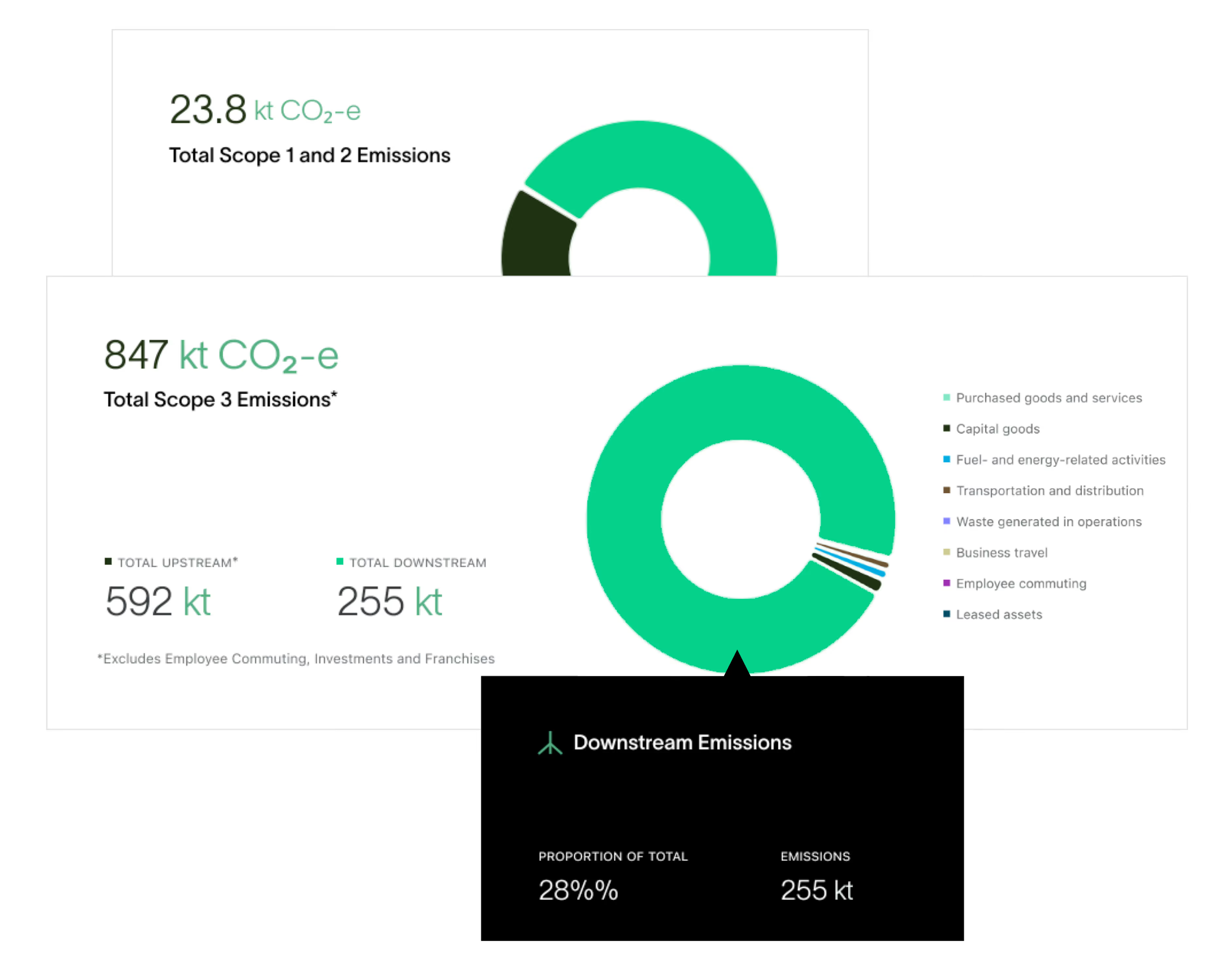
Fair Supply's Emissions Calculator uses physical and activity data to measure your Scope 1 and 2 emissions step by step, with transparent calculations and traceable emissions factors built in.
Trusted by global climate leaders






Take Control of Your Scope 1 & 2 Emissions

Step-by-step data entry
Guided workflows take you through each Scope 1 category and Scope 2 in sequence. Enter your own data directly, or use ABS statistical averages as a starting point.

GHG Protocol-aligned calculation
The right emissions factor is applied automatically for each fuel type, activity and location, sourced from the Australian Government's National Greenhouse Accounts Factors.

Coverage across all Scope 1 and 2 sources
Vehicle fleet, stationary gases, stationary equipment, medicinal gases, refrigerants and industrial processes are each handled with the appropriate methodology. For Scope 2, the correct emission intensity is applied automatically based on your Australian grid location.

Summary report and final snapshot
A summary report is available at every stage, showing your emissions by category. When you're ready, export a final snapshot documenting your methodology and results for disclosure or assurance purposes.
Direct emissions. Direct accountability.
Why Scope 1 and 2 Matter
Scope 1 and 2 emissions form your complete operational footprint. They are the emissions generated directly by your own facilities, fleet and processes, plus the electricity you purchase and consume. Under Australian Sustainability Reporting Standards, Scope 1 and 2 emissions are subjected to limited assurance in the first year of reporting.
For many mining, construction, logistics and agriculture companies, Scope 1 and 2 are where the majority of emissions exposure sits. Get the measurement right to support credible reporting.

Investor & Lender Expectations
Capital markets are increasingly factoring climate risk into investment and lending decisions. A credible, well-documented Scope 1 and 2 baseline supports conversations with boards, lenders and institutional investors.
Customer & Procurement Requirements
Emissions disclosure is becoming more frequently requested in procurement processes and supply chain due diligence. Having a measured, documented Scope 1 and 2 inventory puts you ahead of the request.
The Foundation for Net Zero
You can't reduce what you haven't measured. A defensible Scope 1 and 2 baseline is the starting point for setting credible reduction targets and demonstrating progress year on year.
Scope 1 and 2 Emissions Reporting Obligations
Under mandatory ASRS rules, Australian businesses must report Scope 1 and 2 emissions in their first year of reporting, and annually thereafter.
Unstructured Scope 1 data
Guided step-by-step workflow for Scope 1 data
Scope 2 data requires manual lookup of state-specific grid factors
Scope 2 emission intensity automatically applied by grid location
CO₂-e conversions are done manually
CO₂-e conversion is handled automatically using current IPCC GWP values
No fallback for missing data
ABS averages available where own data isn't yet collected
Audit trail compiled manually at the end
A full audit trail of every entry, factor and underlying methodology is maintained
Slower process with manual data gathering, calculation and compilation
Faster guided process with calculations handled automatically throughout
- Unstructured Scope 1 data
- Scope 2 data that requires manual lookup of state-specific grid factors
- Carbon dioxide equivalent conversions done manually
- Audit trail compiled manually
- Slower process with manual data gathering, calculation and compilation
- Guided step-by-step workflow for Scope 1 data
- Scope 2 emission intensity automatically applied by grid location
- Carbon dioxide equivalent conversion handled automatically
- Full audit trail maintained automatically
- Faster process with automatic calculations



Companies like yours are getting visibility into their risks
FAQs
Don't see what you're looking for?
What is included in Scope 1 emissions?
Scope 1 covers all direct greenhouse gas emissions from sources your organisation owns or controls. Under the GHG Protocol, this includes:
- Stationary combustion: boilers, generators, furnaces
- Mobile combustion: company-owned vehicles and fleet
- Fugitive emissions: refrigerant leaks, gas pipeline losses
- Emissions from manufacturing or processing chemicals and materials (e.g. aluminum, ammonia)
- Process emissions: chemical reactions in manufacturing
- Agricultural emissions: livestock, fertiliser use
If your organisation burns fuel, operates a fleet, uses refrigerants, or runs industrial processes, those emissions fall under Scope 1.
What is included in Scope 2 emissions?
Scope 2 covers indirect emissions from purchased electricity. These are emissions that occur at the power station generating the electricity that you consume.
Is Scope 1 and 2 reporting mandatory in Australia?
Yes. Under Australia's mandatory climate disclosure regime (ASRS), entities must report Scope 1 and Scope 2 emissions as part of their sustainability report.
- Group 1 entities began mandatory reporting from 1 January 2025.
- Group 2 entities begin reporting for financial years starting on or after 1 July 2026.
- Group 3 entities begin reporting for financial years starting on or after 1 July 2027.
Separately, entities meeting NGER thresholds have been required to report Scope 1 and 2 emissions to the Clean Energy Regulator for years. ASRS now layers climate-related financial disclosures on top of this.
What emissions factors does Fair Supply use for Scope 1 emissions?
Fair Supply applies current NGER and GHG Protocol emissions factors for each fuel type (diesel, LPG, natural gas, coal, etc.), geographic location, and activity category.
- Factors are sourced from the Australian Government's National Greenhouse Accounts (NGA) - Factors workbook, which is updated annually.
- CO₂-e conversions are handled automatically using the latest IPCC Global Warming Potential (GWP) values.
You don't need to manually look up or update factors each reporting year.
What data do we need to get started with Scope 1?
At a minimum, you need:
- Fuel purchase records (fuel cards, invoices, meter reads) for your operational sites and vehicles
- Refrigerant top-up records if you operate HVAC or cold-chain equipment
Fair Supply’s platform lets you centralise this data into a single, governed repository. You don't need everything perfectly organised before starting. The platform is designed to let you create an initial estimate quickly and refine data quality over time.
What emissions factors does Fair Supply use for Scope 2 emissions?
Fair Supply automatically applies the correct grid emission intensity for each of Australia's nine electricity grids. CO₂-e conversions use the latest IPCC global warming potential values.
What data do we need to get started with Scope 2?
Electricity bills for each of your sites are the primary input: kWh by location for the location-based method.
What is the difference between location-based and market-based methods for Scope 2?
Location-based calculates emissions using the average carbon intensity of the electricity grid in the state where your energy is consumed.
Market-based uses the emissions rate tied to your specific energy contract, such as a green energy plan, PPA, GreenPower tariff, or supplier-specific rate. The GHG Protocol requires dual disclosure where feasible. Fair Supply's calculator applies the location-based method using current National Greenhouse Accounts grid factors by state.
Who reports Scope 2 emissions, us or our landlord?
Generally, whoever holds the electricity contract reports it as Scope 2. If you receive the electricity bill, it’s likely that you will need to report on those as part of your Scope 2 emissions.
If electricity is bundled into rent and paid by the landlord, it typically falls under Scope 3 Category 8 rather than Scope 2. Sub-metering arrangements can add complexity, so getting boundary setting right from the start will be important for both accuracy and assurance.
What assurance requirements apply to Scope 1 and 2 data, and when?
Assurance is phased in progressively under ASRS:
- Year 1: Limited assurance, covering governance, strategy, and Scope 1 and 2 emissions disclosures.
- Years 2 and 3: Limited assurance requirements expand across all components of the sustainability report.
- Year 4 onward (from 1 July 2030): Reasonable assurance is required.
Fair Supply builds the documented methodology and an immutable audit trail from day one, so you're not reconstructing evidence at audit time.
We only need Scope 1 and 2 right now. Is Fair Supply more than we need?
Not at all. Fair Supply's Scope 1 and 2 Calculator works as a standalone module. You can start with just these and produce audit-ready inventories without engaging with Fair Supply’s Scope 3 solution.
However, it is recommended to begin preparing for Scope 3 emissions early on. Under ASRS, Scope 3 reporting becomes mandatory from your second reporting period. Choosing a provider that only covers Scope 1 and 2 means you might have to deal with data and methodology discontinuity later on.
Fair Supply lets you start simple and scale into Scope 3 on the same platform over time, with consistent methodology and a single audit trail. There's no need to start from scratch or migrate to a different provider.
Report your Scope 1 & 2 emissions with confidence
No obligations, no commitment, no credit card required. Get in touch and and we'll show you how Fair Supply helps you create a complete, audit-ready Scope 1 & 2 inventory.