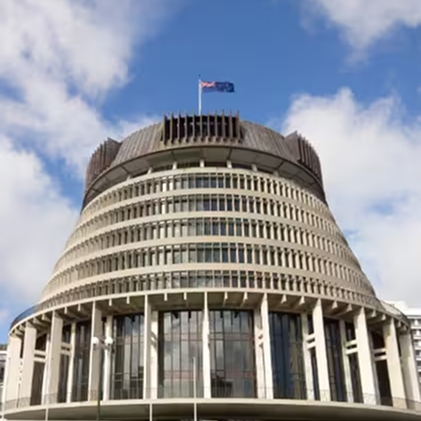
Where the Bill sits today NZ Parliament · Legislative process
Introduced

Bill enters the House

First Reading

Referred to Select Committee

Select Committee

Public submissions & committee report

In progress
Second & Third Readings

Debate, amendment, and final vote

Royal Assent

The Act is expected to come into force 6 months after Royal Assent

Credible reporting takes evidence and time. Organisations that prepare early are more likely to report with confidence.

The New Zealand Modern Slavery Bill is still before Parliament, and requirements may shift before it becomes law. Our team tracks its progress and amendments, so the framework you build with Fair Supply keeps pace as the requirements finalise.

Compliant from Day 1.

If enacted, Aotearoa New Zealand's regime is expected to go further than comparable frameworks in Australia and the UK. With stronger enforcement mechanisms and financial penalties for non-compliance, it will set a world-leading standard.
What your statement must cover

01Reporting entity & structure

Who you are and how your organisation and supply chains are structured.

02Modern slavery incidents

Description of any incidents within operations and supply chains.

03Known or anticipated risks

Description of known or anticipated risks of modern slavery.

04Actions taken

Steps to assess, prevent, address, mitigate and remediate modern slavery.

05Complaints & remediation

Number of complaints made, and any mitigation and remediation provided.

06Effectiveness measures

Measurements of effectiveness and continuous improvement.

07Training provided

Any modern slavery training provided across the organisation.

08Employee consultation

Consultation undertaken with employees in operations and supply chains.

09Prescribed information

Any further information prescribed under the regulations.

How it works

Fair Supply supports your organisation to be compliant with every anticipated reporting requirement, right from the start.
STEP 01 · IDENTIFY

Map where modern slavery risk sits in your supply chain.
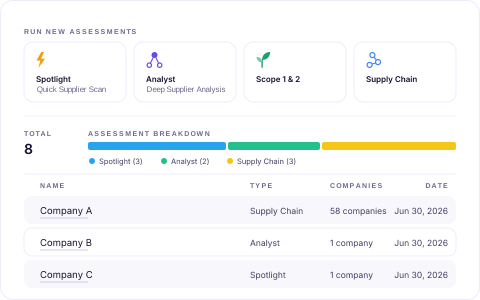
Rapidly and systematically screen every supplier to baseline your modern slavery risk by geography and industry.

Get started with just supplier names and spend. Fair Supply's platform cleans, classifies and scores your data in the background, no manual research required.
STEP 02 · ASSESS

Prioritise risk across your entire supply chain

Apply a prioritised, risk-based assessment of your whole supplier network, including the deep tiers most assessments never reach.

Surface cited reports of forced labour, regulatory action and media issues from validated third-party sources, and build a defensible audit trail as you go.
STEP 03 · ENGAGE

Turn risk insight into defensible due diligence.

Engage prioritised suppliers with structured Self-Assessment Questionnaires (SAQs) that are sent, and automatically tracked and scored.

Every response strengthens your evidence base.
STEP 04 · REPORT

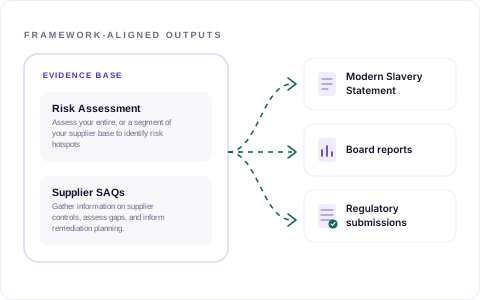
Build the evidence base for your Modern Slavery Statement.
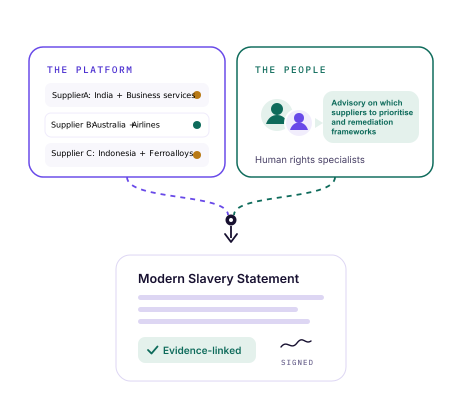
Framework-aligned data outputs you can export and include in your modern slavery statement, board reports and regulatory submissions.

When the first statement is due, you'll be ready.

Platform and people, together

You're never left to interpret the legislation on your own.

Fair Supply pairs a purpose-built risk platform with deep modern slavery expertise honed over years of guiding organisations across mature reporting regimes globally. You're never left to interpret the legislation, wrangle data, or draft a statement on your own.

From your first supplier risk map to the statement you submit, we're alongside you.

Educational Resources

Go deeper on the legislation.
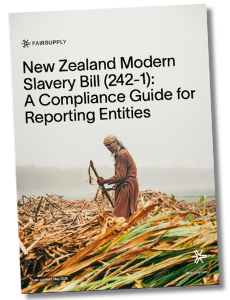
Free compliance guide

Know exactly what the Bill asks of you.

A plain-English walkthrough of the proposed reporting regime: who it captures, what a compliant statement must cover, how it compares to the Australian Modern Slavery Act, and the steps to take now.

Modern slavery expertise

Led by a lawyer who's helped shape the legislation.

Kimberly Randle, Human rights lawyer
CEO & Co-Founder of Fair Supply

Kim has spent more than 15 years working in law and human rights across Australia and the United States, including as Senior Director of Corporate and Legal for International Justice Mission Australia. She founded Fair Supply to close the gap between what modern slavery legislation demands and what businesses can actually see in their supply chains.

She is a sought-after expert on modern slavery regulation, called on to give evidence and submissions to parliamentary inquiries on both sides of the Tasman.

View Fair Supply's submission to New Zealand Parliament (Pāremata Aotearoa)

Built for a connected market

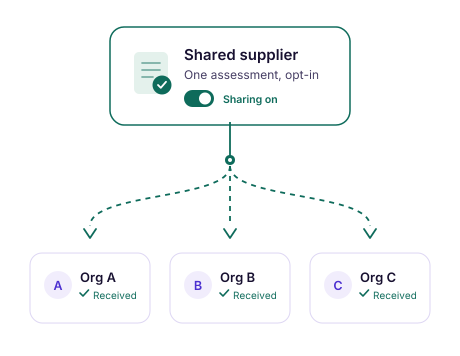
A database of shared questionnaire responses

In a market like Aotearoa New Zealand, supplier networks overlap constantly. With Fair Supply, a supplier can complete an assessment once and if they opt in, share it with the other organisations that need it.
  • Less supplier fatigue. Fewer repeated forms means suppliers respond faster and with higher-quality answers.
  • Better data across the market. Shared assessments raise coverage across a tightly connected market.
  • Effort where it matters. Direct your team's time to the suppliers and risks of greatest strategic impact.

Why companies choose Fair Supply


Data for defensible compliance
Your risk estimates are only as good as the model behind them. Built on globally established MRIO analysis, we can map the deepest tiers of your supply chain most assessments never reach.
Expert guidance included
Our human rights and supply chain specialists are on hand to help you interpret findings and prioritise action. You won’t be stuck with a dashboard and no direction.
Results in days, not months
We model risk directly from trade data, so you don't need to manually chase up supplier responses to get an initial risk map. Your supplier list and spend data is all you need to get started.
Deep dive on any supplier in the world
Instantly surface risk flags, media allegations and known issues. Then choose to engage a supplier with targeted surveys.
Streamlined, regulation-ready outputs
Fair Supply works so that your path from risk assessment to signed statement is short, and every claim traces back to evidence.
One platform for all of your ESG needs
All of Fair Supply’s ESG modules run on the same supply chain model with different data overlays, so one set of inputs delivers a comprehensive view across all of your ESG risk.
?

Don't see what you're looking for?

We're here to answer any questions about Fair Supply.
Ask Our Team

What is the New Zealand Modern Slavery Bill?

New Zealand has introduced a landmark Modern Slavery Bill to strengthen protections for workers and improve supply chain transparency. The legislation will require large businesses to publicly report on modern slavery risks and the actions they are taking to address them.

New Zealand’s proposed legislation is a pivotal step toward stronger supply chain accountability. Enterprises that act early will protect workers, safeguard exports, and maintain trust with global partners.

The Modern Slavery Bill will introduce:

  • Mandatory public reporting for organisations over NZ$100M revenue
  • Disclosure of complaints and incidents found
  • Penalties for non-compliance and director liability
  • Stronger expectations from investors and trading partners

If the Bill passes, who will need to comply with the new requirements?

The Bill is expected to apply to organisations with annual revenue above NZ$100 million, meaning many of New Zealand’s largest companies will soon face mandatory reporting obligations.

Which companies will have to report under the New Zealand Modern Slavery Bill?

The Bill proposes mandatory public reporting for organisations above a revenue threshold (reported as NZ$100M). Many large New Zealand companies, subsidiaries, and entities operating across NZ supply chains should prepare now.

What data do we need to get started in Fair Supply’s platform?

You can start with supplier name, country, and spend. Fair Supply generates an objective baseline using modelling and authoritative datasets—then helps you deepen due diligence where risk is highest.

Which organisations will need to report?

Reporting obligations are expected to apply to larger organisations operating in Aoteara New Zealand. For more information about what needs to be reported, see Fair Supply’s free Compliance guide.

We already report under the Australian Modern Slavery Act, does that cover us in New Zealand?

Not automatically. New Zealand entities with Australian reporting obligations will still need to prepare a separate statement to comply in Aotearoa New Zealand, unless a joint modern slavery reporting template that covers multiple jurisdictions is released. Fair Supply’s platform supports reporting in both jurisdictions from the same underlying supply chain model, so the risk mapping carries across.