
platform Methodology
How Fair Supply models supply chain risk
Fair Supply combines a global economic model of supply chains with company-specific evidence to assess a supplier's modern slavery, emissions and biodiversity risk.
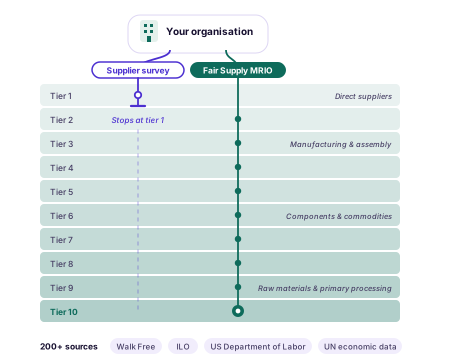
The model traces risk 10 layers deep into complex global supply chains. The company-specific information identifies documented incidents, sanctions and high risk products and services, each cited to a verified source.

Defensible by design
Breadth and depth, for a comprehensive risk picture
This approach combines visibility across complex supply chains with detailed supplier level intelligence. This approach supports proportionate, informed and defensible risk management decisions.
Layer 1
Layer 2
Layer 1: Global economic layer
How does Fair Supply identify supply chain risk to Tier 10?
The model establishes a detailed economic profile of the inputs required to produce goods and services across individual countries and industries. When assessing a supplier, Fair Supply traces these interdependencies through successive layers of the supply chain, extending beyond direct suppliers to identify upstream economic relationships and associated risk exposures across up to 10 tiers.
At each tier of the supply chain, Fair Supply applies relevant modern slavery, greenhouse gas emissions and biodiversity risk data to the underlying economic relationships, enabling the quantification of potential exposure across each risk category.
Why tier depth matters for modern slavery risk
By modelling economic relationships across up to 10 tiers, Fair Supply enables organisations to identify potential modern slavery exposure associated with upstream commodities, industries and jurisdictions, including where direct suppliers operate in comparatively lower-risk sectors.
It also supports organisations in meeting their reporting obligations under section 16(1)(c) of the Modern Slavery Act 2018 (Cth), which requires reporting entities to describe the risks of modern slavery practices in their operations and supply chains, including those of entities they own or control.
Organisation identification and classification
Read how AI supports matching and classification →
How Fair Supply risk ratings work
To make these figures easier to interpret, compare and act on, Fair Supply also gives each supplier a five-point rating, from Low to High. Each rating covers a set range of estimated risk.
The five categories are not even splits. Forced labour is concentrated in a small number of high-risk industry and country combinations, so the boundaries are weighted by each combination’s share of global economic activity. They come from a consistent, repeatable calculation rather than a subjective judgement.
Layer 2: company-specific information
Reported issues, sanctions and flagged products
Together, these complementary approaches provide a more comprehensive and defensible basis for identifying, assessing and prioritising supply chain risks.
Each identified issue is supported by a source reference and publication date to facilitate verification, transparency and further investigation.
The identification of a higher risk good or commodity does not constitute an allegation or finding of misconduct against an individual supplier. Rather, it indicates a potential area of exposure warranting further, proportionate and risk-based due diligence.
Frameworks the methodology supports
FAQs
Don't see what you're looking for?
How does the Fair Supply platform work?
Fair Supply assesses supply chain risk using Multi-Regional Input-Output (MRIO) analysis. This is a proven, auditable way of mapping the connections within global supply chains. With just a supplier’s name and your spend with them, Fair Supply models the supply chain behind that spend using the typical flow of goods and services for a business of its industry and geographic location. This modelling takes place across every tier and thousands or millions of transactions. Impact data (for example, the number of people in forced labour by industry and country) is overlaid on the supply chain links and turned into a measure of risk exposure.
What is MRIO analysis, and why does Fair Supply use it?
Multi-regional input-output (MRIO) analysis is an established economic methodology that maps the financial relationships between industries and economies using national accounts data published by official statistical agencies.
Fair Supply applies its proprietary MRIO model to trace the economic inputs underpinning a supplier’s goods and services across up to 10 tiers of the global supply chain. By integrating modern slavery, greenhouse gas emissions and biodiversity risk data with these economic relationships, Fair Supply enables organisations to quantify potential risk exposure beyond their direct suppliers, providing a more comprehensive and evidence-based foundation for supply chain due diligence.
What makes Fair Supply different from other ESG risk platforms?
Unlike approaches that rely primarily on industry averages, supplier self-reported information or scoring methodologies with limited transparency, Fair Supply integrates proprietary economic modelling with authoritative global datasets and supplier-specific intelligence to deliver a comprehensive, evidence-based assessment of supply chain risk.
By combining internationally recognised multi-regional input-output (MRIO) methodology with documented company level information, Fair Supply enables organisations to assess suppliers globally across multiple environmental and human rights risk categories, without requiring extensive manual analysis or specialist supply chain expertise.
Importantly, Fair Supply applies a single, consistent economic model to quantify multiple dimensions of supply chain impact, including greenhouse gas emissions, biodiversity and modern slavery. This integrated approach provides organisations with a more comprehensive and comparable understanding of risk exposure, supporting informed decision-making, proportionate due diligence and defensible reporting.
Does Fair Supply assess ESG risk beyond Tier 1 suppliers in the supply chain?
Yes. Fair Supply models economic relationships across up to 10 tiers of the supply chain, enabling organisations to identify and assess potential environmental, social and governance (ESG) risks embedded in upstream activities that may not be visible through direct supplier assessments alone.
How does Fair Supply assess supplier biodiversity risk?
Biodiversity impact is measured through nSTAR scores that combine economic activity, habitat overlap, and species threat data from IUCN and IBAT.