Australia's Modern Slavery Act is getting teeth: what the “failure-to-prevent” offence means for business

Executive Summary

  • On 16 July 2026, Attorney-General Michelle Rowland announced the Albanese Government's intention to create a new criminal offence for large companies that fail to prevent modern slavery in their operations and supply chains, together with civil penalties for non-compliance with the existing Modern Slavery Act 2018 (Cth).

  • The proposed offence would apply to entities with annual consolidated revenue over $100 million and would carry a defence where a company can show it took “reasonable steps” to prevent modern slavery.

  • Nothing has been set as law yet. The government will undertake consultations to inform next steps.

  • When implemented, this would be the most significant shift to the Modern Slavery Act since it was first enacted, demonstrating a shift from a transparency regime toward one built on action and accountability for managing modern slavery risks in corporate supply chains. 

What was announced

In a press release on Thursday, July 16, The Government announced it will introduce a new criminal offence for failing to prevent modern slavery. It would apply to companies with annual consolidated revenue of over $100 million. 

According to the Global Slavery Index, there are approximately 41,000 people in Australia living in conditions of modern slavery. Australia is also connected to global supply chains at risk of forced labour through its imports. Fair Supply’s own research and modelling, conducted in partnership with Walk Free, estimates that nearly $100 billion worth of goods imported into Australia are exposed to modern slavery risks, representing a fifth of Australia’s total imports.

Under Australian law, Modern Slavery is defined as covering the following crimes:

  • Human trafficking
  • Slavery
  • Forced labour
  • Forced marriage
  • Servitude
  • Debt bondage
  • Deceptive recruiting for labour services
  • Worst forms of child labour

A company would have a defence against penalties if it can demonstrate that it took reasonable steps to prevent modern slavery. 

The government has also announced civil penalties and enforcement powers for non-compliance with reporting obligations that already exist under the Modern Slavery Act 2018

Details on the proposed legislation and its enforcement will be shaped through a consultation process.

Background on the Modern Slavery Act 

The Modern Slavery Act 2018 (cth) commenced on 1 January 2019 and, in its current form, is a transparency instrument. Entities carrying on business in Australia with annual consolidated revenue of $100 million or more must publish an annual statement covering the following criteria:

  • Identity of reporting entity
  • Description of the reporting entity’s structure, operations and supply chains
  • Description of the risks of modern slavery practices in the operations and supply chains of the reporting entity and any entity it owns and controls.
  • Description of the actions taken by the reporting entity and any entities it owns or controls to assess and address these risks, including due diligence and remediation processes.
  • Description of the effectiveness of how these actions are assessed.
  • Description of the process of consultation with any entities the reporting entity owns or controls 
  • Any other relevant information.

There is currently no obligation to act, only to report on any modern slavery risks identified, and there are also currently no civil or criminal penalties for non-compliance. 

In May 2023, a statutory review of the Act (led by Professor John McMillan AO) was tabled. It found that the Act’s reporting-only approach did not go far enough to address modern slavery and recommended imposing a mandatory human rights due diligence system. The Review put forward 30 recommendations. In December 2024, the government released its official response, in which it accepted 25 of the recommendations in principle and noted the remaining five. 

In parallel, the Government established an independent Australian Anti-Slavery Commissioner, a role held since 2 December 2024 by Chris Evans. Commissioner Chris Evans released an initial position paper on 30 January 2026 with the recommendation to introduce mandatory risk-based modern slavery due diligence obligation for reporting entities. 

Seen against that backdrop, the 16 July announcement is seen as a step to address the criticism and to bolster Australia’s response to combatting modern slavery in supply chains. In the Attorney-General's words, “the proposed changes will introduce greater accountability, levelling the playing field for the majority of Australian businesses already doing the right thing,”

What businesses should do now

Organisations can take sensible and proportionate steps to prepare early, including:

  • Treating the annual modern slavery statement as a way to implement a robust modern slavery risk management process, as opposed to a box-ticking compliance exercise.

  • Mapping supply chains beyond tier one, and understanding where there may be visibility gaps, with a plan on how to address them.

  • Reviewing whether existing due diligence, supplier engagement and grievance mechanisms would stand up as defensible evidence ahead of any “reasonable steps” requirement.

  • Engaging with the government's consultation process and to seek training for their boards, executives and procurement teams to stay informed on upcoming changes.

This article is general information current as at 17 July 2026 and is not legal advice. The reforms described are proposed and subject to consultation. Specific obligations should be confirmed against the legislation once introduced.
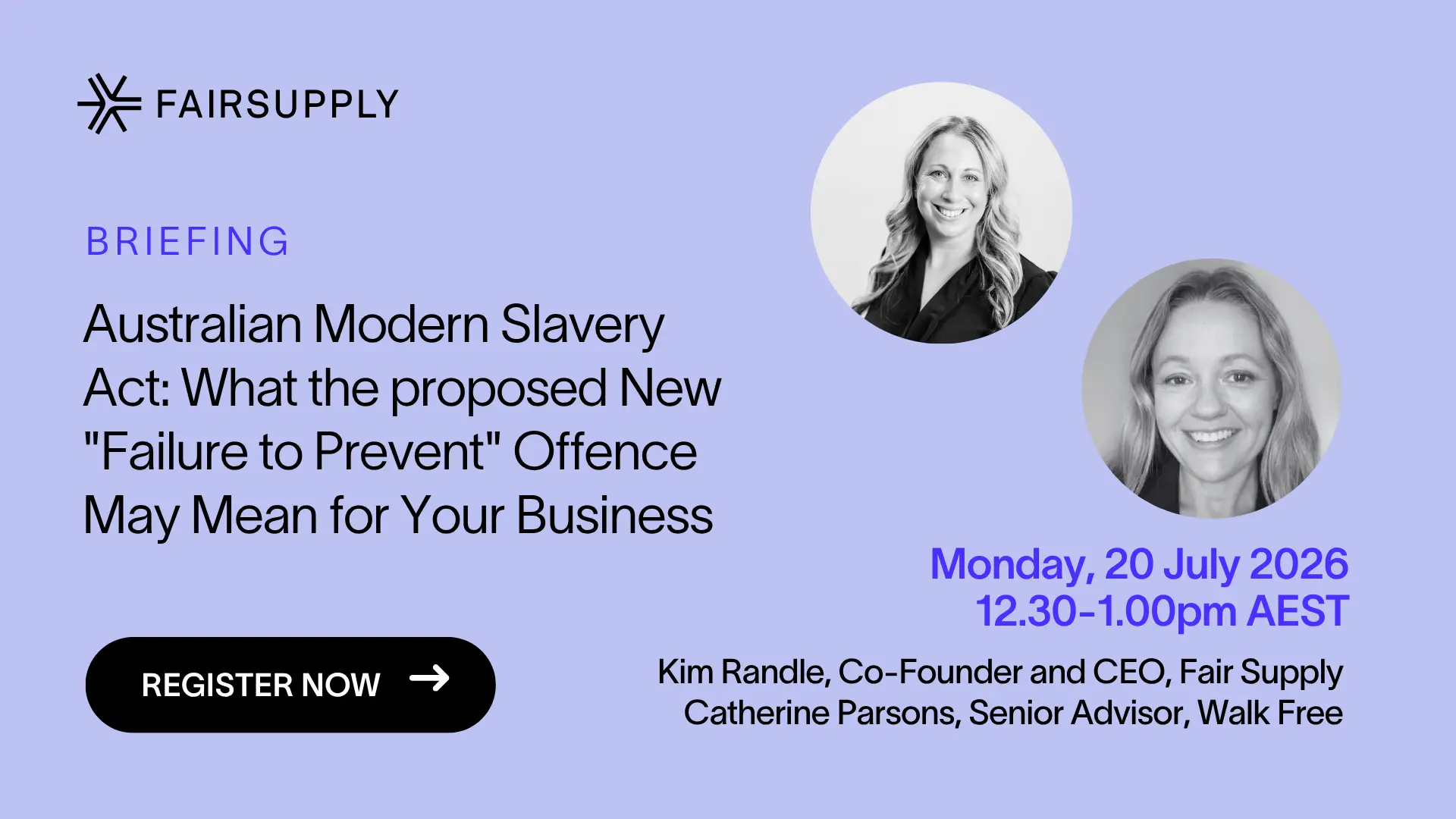
Join our upcoming briefing on reforms to Australia's Modern Slavery Act

Fair Supply is hosting a briefing to unpack what the proposed criminal offence and civil penalties could mean for reporting entities, and the practical steps businesses can take now to prepare. We'll cover the "reasonable steps" defence, supply chain mapping beyond tier one, and how to make your existing due diligence defensible ahead of any new obligations.

Date: Monday, 20 July 2026
Time: 12.30pm- 1.30pm AEST

Please register using this link.

Featured Report

This is some text inside of a div block.

The Albanese Government has announced plans to criminalise failure to prevent modern slavery for large companies, marking the most significant shift to the Modern Slavery Act since it was enacted.
As founder and CEO of Fair Supply, Kimberly is an experienced and innovative human rights advocate specialising in modern slavery. Kimberly has over 15 years experience working in law and human rights for top tier firms in Australia and the United States, previously holding the role of Senior Director of Corporate and Legal for International Justice Mission Australia. Kimberly is a sought-after expert and speaker in the field of modern slavery and has been called upon to provide evidence for both the NSW and Commonwealth Parliamentary Inquiries into Human Trafficking. Kim received her Bachelor of Law from Macquarie University.
Kimberly Randle
Co-founder & CEO
LinkedIn Profile
As founder and CEO of Fair Supply, Kimberly is an experienced and innovative human rights advocate specialising in modern slavery. Kimberly has over 15 years experience working in law and human rights for top tier firms in Australia and the United States, previously holding the role of Senior Director of Corporate and Legal for International Justice Mission Australia. Kimberly is a sought-after expert and speaker in the field of modern slavery and has been called upon to provide evidence for both the NSW and Commonwealth Parliamentary Inquiries into Human Trafficking. Kim received her Bachelor of Law from Macquarie University.

Related Solutions

No items found.