
Contents
Scope 3 Emissions: A Practical Guide to Calculating and Future Reporting in Australia
Last updated: September 2025
Executive Summary
For many companies, Scope 3 emissions contribute to the majority of overall climate impact. Unlike Scope 1 and 2 emissions, which are tied to a company’s direct operations and energy use, accurate Scope 3 reporting requires obtaining data from the depths of the company’s value chain. It is typically more complex to measure and manage.
To effectively address Scope 3, most companies will need to develop and integrate new and substantial data collection and analysis processes. Corporate toolkits will need to be built (or substantially upgraded) around large-scale data collection, developing internal expertise to interpret results, and actively engaging both suppliers and cross-functional teams to build a reliable emissions inventory.
“Addressing Scope 3 typically involves integrating new processes for large-scale data collection, developing internal expertise to interpret results, and actively engaging both suppliers and cross-functional teams to build a reliable emissions inventory.”
In Australia, the reporting of Scope 3 emissions is required under the Australian Sustainability Reporting Standards (ASRS). From 1 January 2025, Group 1 reporting entities must disclose Scope 1 and 2 emissions in the first reporting period, with Scope 3 disclosures to be made from the second reporting period. Experts have advised organisations not to wait until reporting deadlines are imminent because Scope 3 data is complex, often spread across multiple suppliers and business units, and can take significant time to collect, validate, and integrate into reporting systems.
This guide provides a practical, step-by-step framework to help organisations establish a structured, formal and foundational approach to building a Scope 3 inventory. A Scope 3 inventory is a comprehensive record of all indirect greenhouse gas emissions across a company’s value chain, both upstream and downstream, that are not covered by Scope 1 or 2.
The framework is organised into five steps:
- Screening
- Materiality assessment
- Calculation methodology
- Data collection
- Refinement and iteration
Scope 3 reporting is complex, but it can drive real impact. By starting early, organisations can establish the systems and capabilities to manage emissions strategically. Critically, reducing Scope 3 emissions depends on meaningful supplier engagement. When done well, compliance becomes a springboard for stronger supplier relationships and long-term value creation.
Understanding Scope 3 Emissions in Context
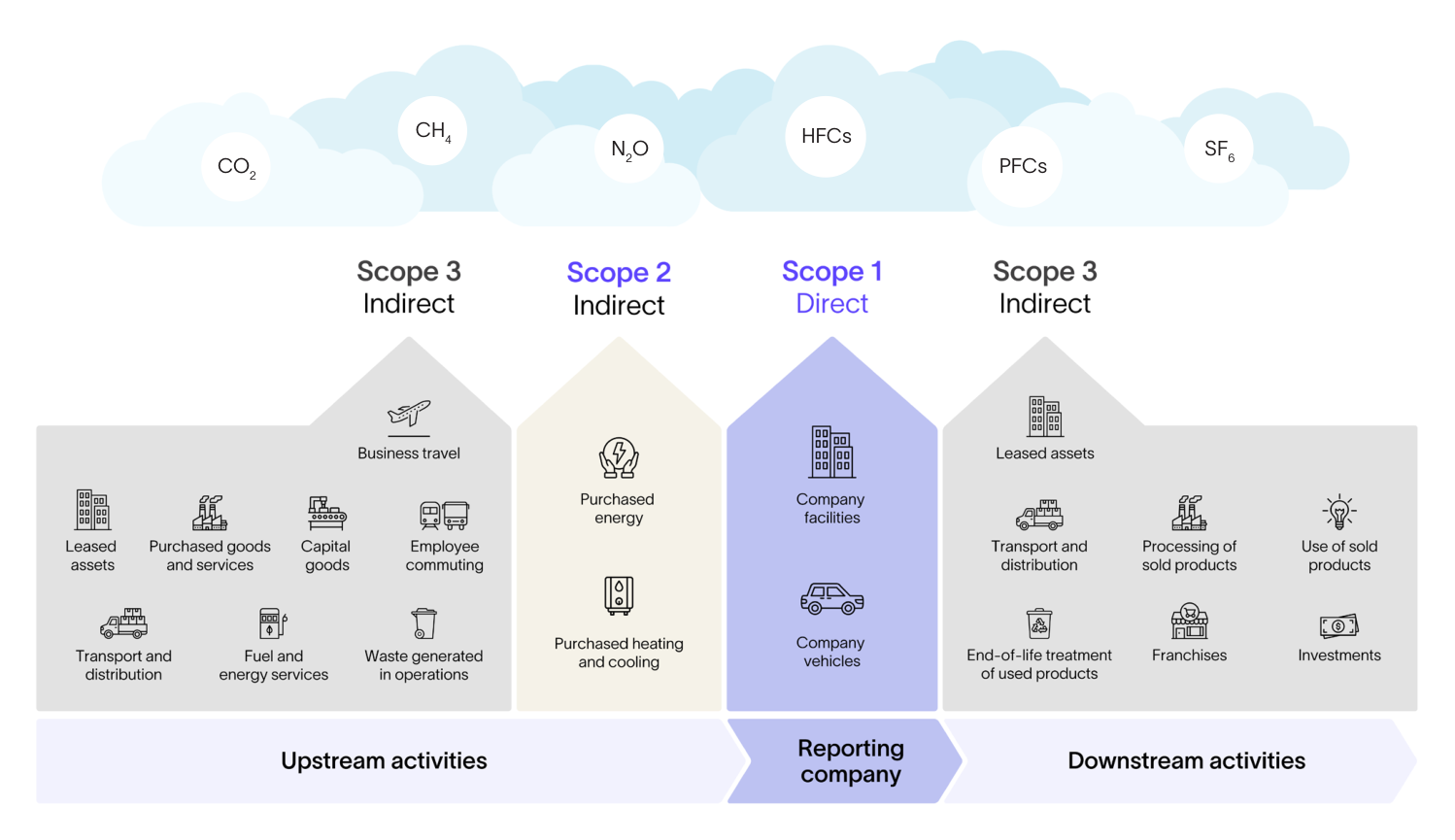
In greenhouse gas accounting, emissions are categorised into three “scopes” under the Greenhouse Gas (GHG) Protocol.
01
Scope 1 covers direct emissions from sources that a company owns or controls, for example, fuel burned in a company’s vehicles or onsite equipment.
02
Scope 2 covers indirect emissions from purchased energy, such as the emissions at a power plant generating the electricity the company uses.
03
Scope 3 emissions include all other indirect emissions that occur across the company’s value chain, both upstream and downstream, that are not already counted in Scope 1 or Scope 2.
A simplified way to think about this is that Scope 1 and 2 emissions are those the reporting company can directly control, whereas Scope 3 emissions are those it can only influence. While this shorthand does not fully capture the Protocol’s definitions, it provides an intuitive way of understanding the distinction between operational emissions and value chain emissions.
The GHG Protocol further breaks Scope 3 emissions into 15 categories.
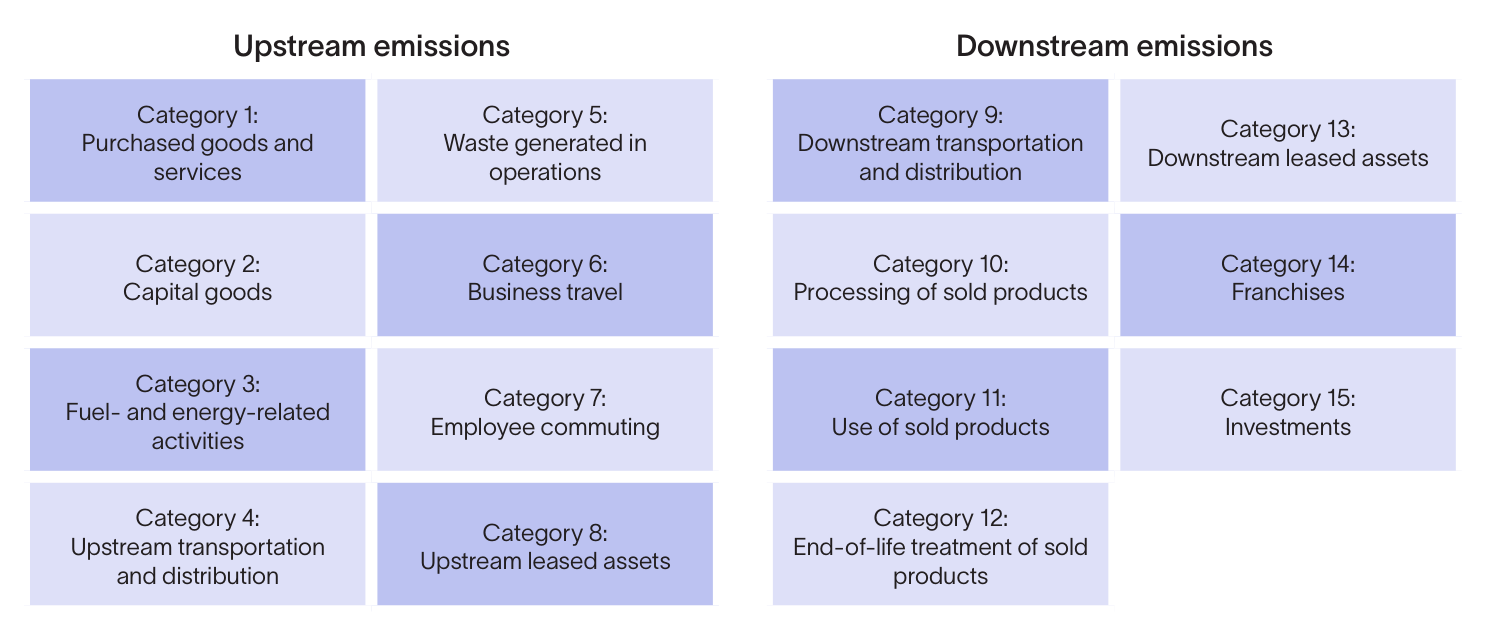
These span:
Upstream activities:
Those that occur in the production and supply of inputs to the company; that is, the goods and services that a company purchases.
Downstream activities:
Those that occur from distributing, using, and disposing of the company’s outputs; the goods and services that a company sells.
Not every category will have significance to every business. For example, some categories may not apply to a particular sector, or may fall below the materiality threshold determined by the organisation. There are established guidelines to help assess significance, but in most cases a degree of subjective evaluation is still required. This guide outlines the key frameworks and approaches to support that process.
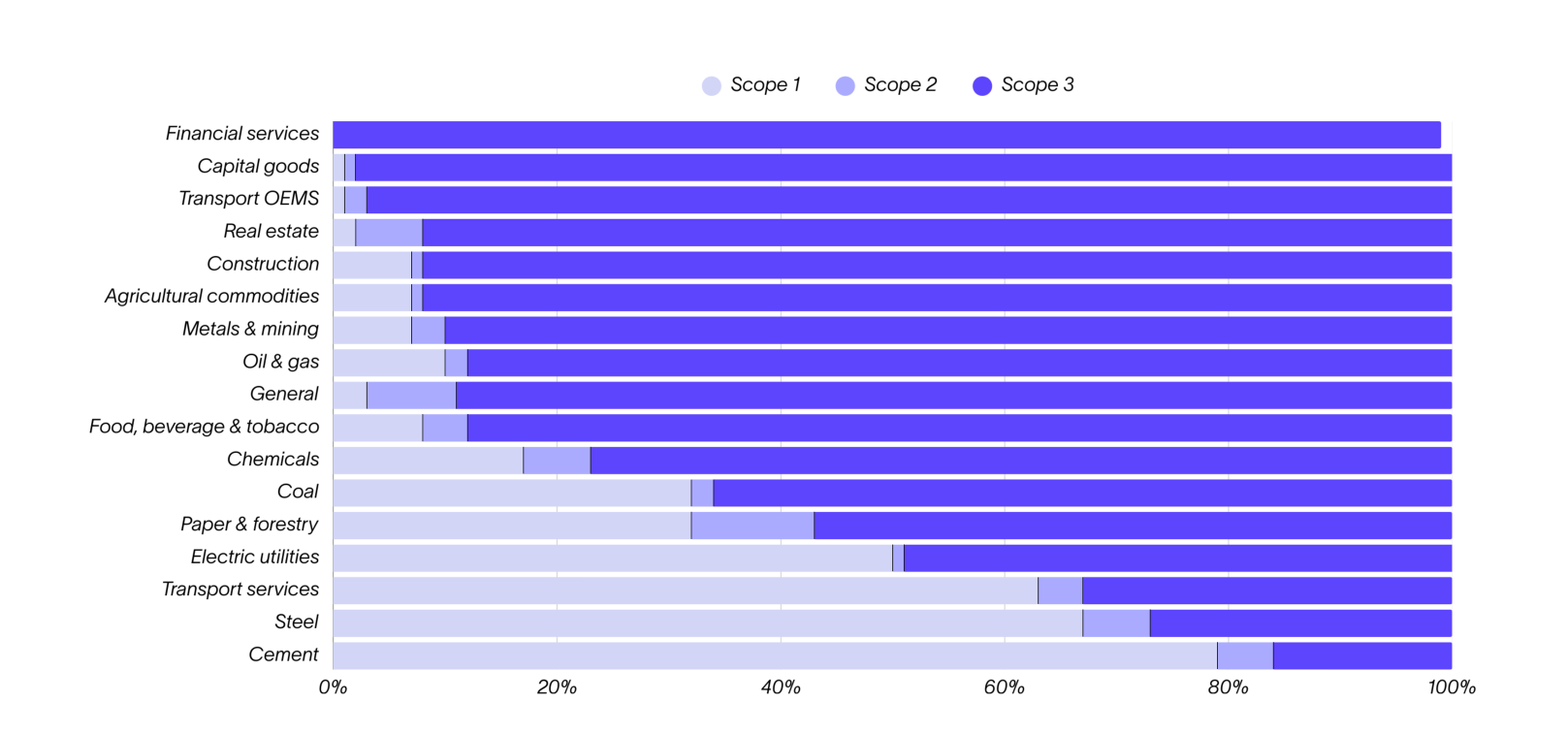
In many industries, Scope 3 makes up the majority of a company’s total carbon exposure. Primary and heavy industrial sectors like cement and transport services have large Scope 1 and 2 emissions from fuel combustion and production processes. Other industries, such as retail, financial services, technology and consumer goods find that value-chain (Scope 3) emissions are the dominant footprint contributor.
For example, the chart in Figure 1.3 on the previous page, drawn from the CDP Supply Chain Report, shows that over 90% of the total GHG impact for a construction company was in its Scope 3 emissions rather than its direct operations1.
This underscores why understanding and addressing Scope 3 is so important, for the simple reason that your company cannot effectively manage what it has not measured. Scope 3 reporting shines a light on otherwise hidden emissions in the value chain. With this knowledge, companies can prioritise the most material areas and work with suppliers and partners on strategies to reduce emissions over time.
Scope 1 & 2 Accounting vs Scope 3 Accounting
From a methodological perspective, accounting for Scope 1 and 2 is often a more straightforward process, and the data collection usually presents the main challenge. Broadly, this involves collecting the reporting organisation’s fuel and electricity usage data and applying the relevant emission factors.
Scope 3 reporting is inherently more complex than Scopes 1 and 2 because it relies on data from external parties and often requires different calculation methods across categories. Companies may need to combine supplier-specific primary data, where available, with secondary sources such as spend-based or industry-average factors.
The Australian Regulatory Context for Emissions Reporting
The Australian Sustainability Reporting Standards (ASRS) and the GHG Protocol
Australia has introduced mandatory climate-related financial disclosures, effective from 1 January 2025, requiring reporting entities to include greenhouse gas emissions as a key component of Sustainability Reporting. These requirements are being implemented via the Australian Sustainability Reporting Standards (ASRS) and associated legislation, which was passed at the end of 2024.
The Australian Sustainability Reporting Standards closely align with the IFRS Sustainability Disclosure Standards. The four key disclosure pillars of the ASRS are as follows: Governance, Strategy, Risk Management, and Metrics & Targets.
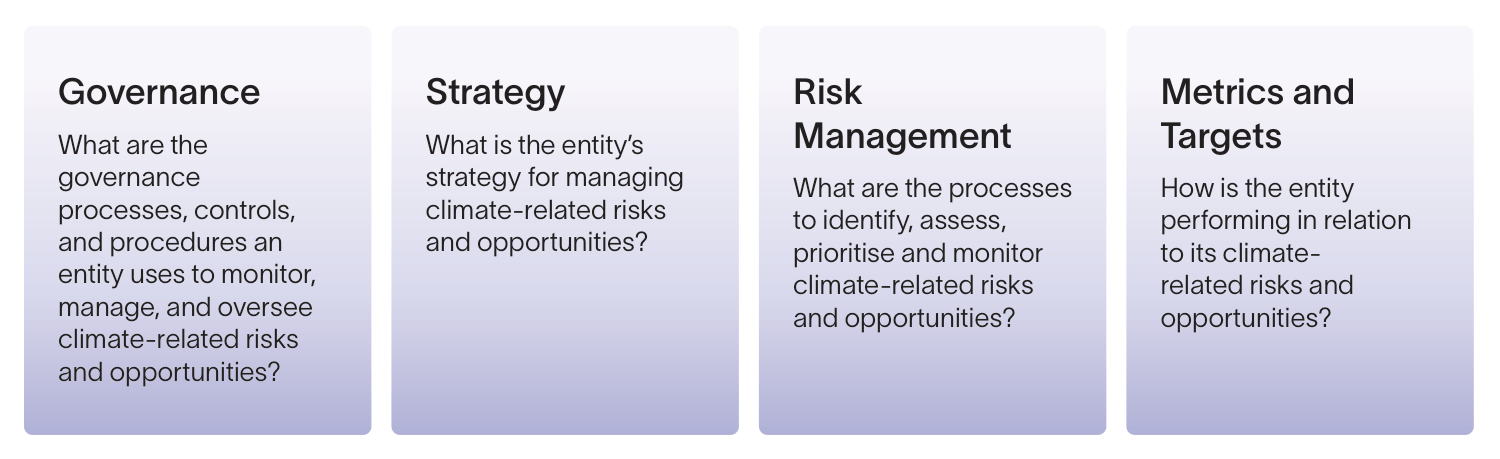
Under the Metrics and Targets pillar, the ASRS mandates that emissions be measured in accordance with the GHG Protocol2. In other words, Australian companies will need to classify emissions by Scope (1, 2, 3) and use GHG Protocol-aligned methods for quantification, ensuring consistency and comparability in reporting.
Australian Sustainability Reporting Standards (ASRS) Reporting Timeframe
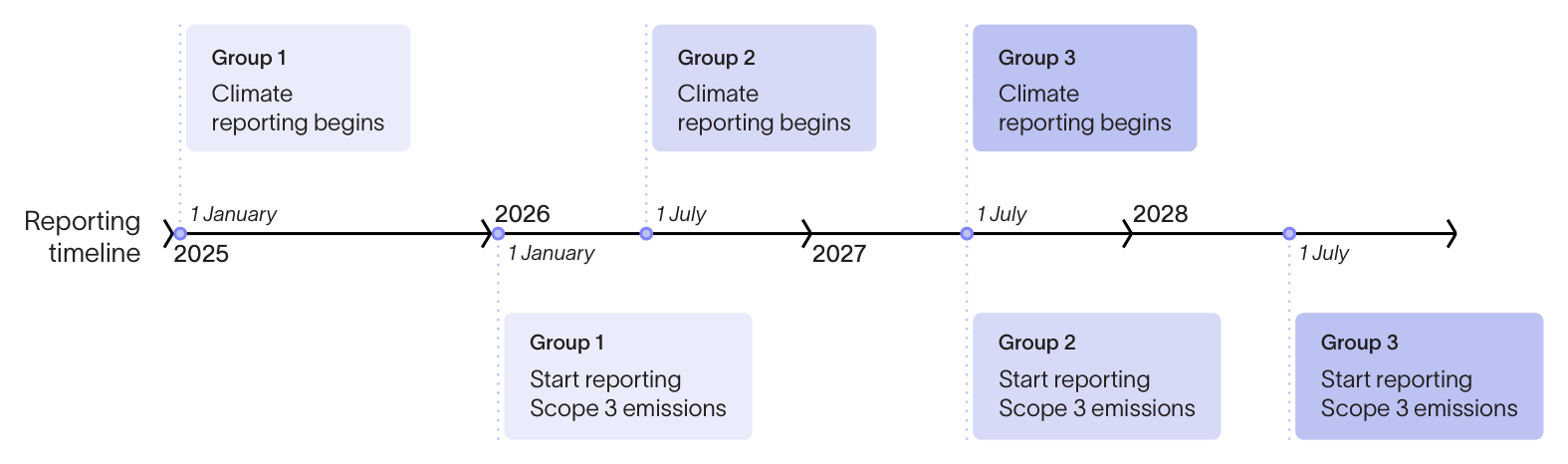
The rollout is phased based on company size, using reporting groups defined by thresholds of revenue, assets, and employees. In summary:
| Reporting group and timeline* Scope 3 reporting | Revenue, assets and number of employeesEntities (and those it controls) that meet two out of three criteria at the end of the financial year: | National Greenhouse and Energy Reporting (NGER) Act | Asset owners(registered scheme, superannuation entity or retail CCIV) | ||
|---|---|---|---|---|---|
| Consolidated revenue | Consolidated gross assets | No. of employees | |||
| Group 1From 1 January 2025 * 1 January 2026 |
$500 million or more | $1 billion or more | 500 or more FTE | Registered (or required to be) under the NGER Act and meets publication thresholds | Scoped out of Group 1 |
| Group 2From 1 July 2026 * 1 January 2027 |
$200 million or more | $500 million or more | 250 or more FTE | Registered (or required to be) under the NGER Act, regardless of publication threshold | $5 billion or more in assets under management |
| Group 3aFrom 1 July 2027 * 1 January 2028 |
$50 million or more | $25 million or more | 100 or more FTE | – | Apply Group 3 reporting thresholds (see left) |
a Limited disclosure for Group 3 entities if they have no material financial risks or opportunities relating to climate.
Each group faces a staggered timeline for Scope 3 reporting. In the first reporting year, companies need to report Scope 1 and 2 emissions only. Scope 3 disclosures become mandatory from the second reporting year onward for each group.
For example, a Group 1 company with a financial year starting on 1 January 2025 would include Scope 1 and 2 emissions in its FY2025 sustainability report, and then add Scope 3 emissions in the FY2026 report (its second year of reporting). Group 2 and 3 entities similarly get a one-year grace period on Scope 3 emissions reporting.
A practical approach is to view Scope 3 as a longer-term process: start now with a screening or high-level estimate, then refine methodologies, improve data quality, and expand supplier engagement over time. This process can assist companies to build capability, strengthen systems, and pursue compliance while positioning longer-term strategic emissions management.
Assurance Standards
The auditor of an entity’s financial report must also provide assurance over the mandatory climate information in the sustainability report. In January 2025, the Auditing & Assurance Standards Board (AUASB) approved the ASSA 5000 standard, which sets out these requirements. The level of assurance will be phased in over a four-year period. Scope 3 disclosures are not required in the first sustainability report. In the second and third years, limited assurance will apply; and from the fourth year onward, reasonable assurance3 will be mandatory.
It is anticipated, based on official guidance published by ASIC to date, that companies will be given the opportunity to progressively improve data and processes rather than face a more stringent enforcement approach from the outset of mandatory reporting. Australia’s legislation also provides a Modified Liability Period in the initial years for Scope 3 emissions and other forward-looking climate disclosures. It seems reasonable to expect that there will be a pragmatic and proportionate regulatory approach, with due recognition being given to the reality that companies’ systems and methodologies are still “works-in-progress”4.
Finally, it’s worth noting that emissions reporting is just one part of the broader climate disclosure picture. Reporting requirements cover the mandatory disclosure of governance arrangements, climate-related risks and opportunities, company strategy, and detailed scenario analysis and targets.
Although mandatory reporting of Scope 3 emissions has been deferred by one year, it is an area best characterised as a near-term requirement. Scope 3 frequently represents the largest share of total emissions. It involves the most complex and labour-intensive data collection and analysis. Consequently, reporting entities should prioritise taking early and comprehensive action. Doing so will assist with achieving compliance with the mandated timeline, strengthen the organisation’s ability to set credible targets and, ultimately, more effectively manage overall emissions.
Many leading Australian companies are already demonstrating attempts at reporting on Scope 3 emissions even though they are not yet required to do so in terms of the legislation. This is a strong indication of where broader public expectations and good practice thresholds are likely to soon land in relation to a broad array of companies being in a position to comprehensively measure, and report on, Scope 3 data.
Developing a Scope 3 Emissions Inventory: A Step-by-Step Framework
Below is a five-step framework to develop a Scope 3 emissions inventory, aligned with GHG Protocol principles and practical guidance from sustainability experts.
Step 1:Screening – Mapping the Big Picture
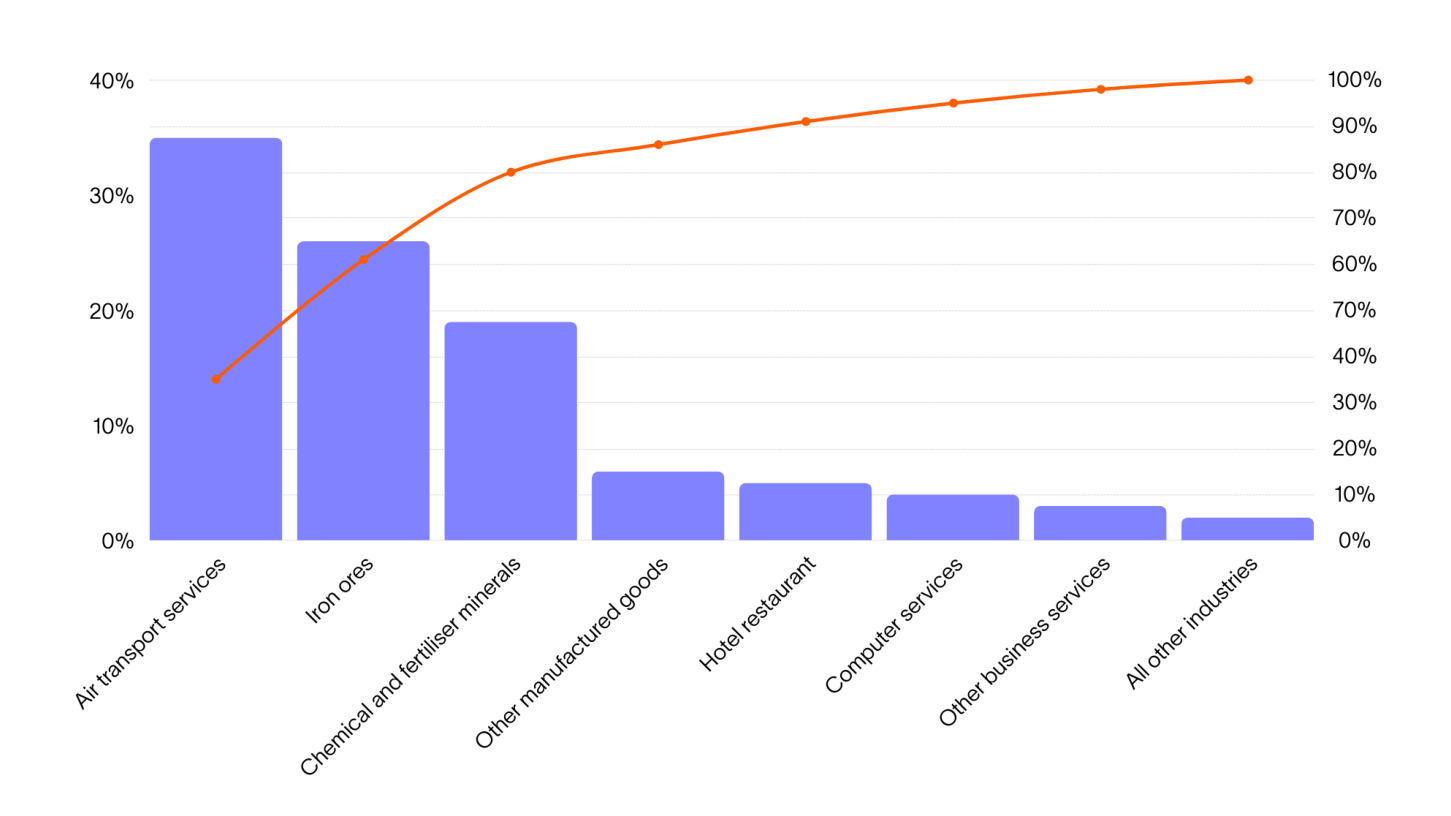
Screening involves an initial high-level assessment of your company’s value chain. Think of it as triage: before diving into detailed calculations, you want to know which of your company’s suppliers, purchase categories, or activities are responsible for the bulk of indirect emissions.
A screening provides an initial estimate of emissions across all Scope 3 categories, using available data and established methodologies. Commonly, this involves spend-based analysis: taking procurement spend data and applying industry-average emissions factors from Environmentally-Extended Input-Output (EEIO) models5. This provides a preliminary emissions profile without requiring supplier-specific data at the outset.
The purpose of screening is directional rather than definitive: it gives reporting entities a map of where emissions are likely to be concentrated, or what are commonly known as ‘emissions hotspots’. In many organisations, a small proportion of suppliers or categories accounts for the vast majority of emissions. This allows your company to prioritise efforts. Rather than treating hundreds or thousands of suppliers equally, you can zero in on the most material sources of emissions first. Screening outputs may be better viewed as a useful diagnostic tool to guide priority-setting (rather than as final reporting figures).
Step 2:Materiality Assessment – Determining What Counts
With screening results in hand, the next step is to conduct a materiality assessment for Scope 3 emissions. This means deciding which sources and categories of emissions are significant enough to warrant detailed measurement and management.
There is no hard-and-fast rule for this threshold. Most companies aim to capture the vast majority of emissions while avoiding unnecessary detail. For example, they might decide to focus on all sources that together account for 90-95% of total estimated Scope 3 emissions, or apply a cutoff such as any category contributing more than 5% of total emissions as being material. The choice of threshold is left to the company, but it should be clearly disclosed and consistently applied6.
The screening analysis provides the evidence to make these calls. If Purchased Goods and Services (Category 1) and Capital Goods (Category 2) make up most of your company’s footprint, they will be clearly material. Alternatively, if Business Travel (Category 6) and Employee Commuting (Category 7) represent only a small share of the company footprint, you may still record these categories for completeness, but it usually will not justify the same level of attention and detail.
Materiality is not just about numbers. Determining what is material is highly subjective, as some carbon sources may be considered more significant due to strategic relevance, stakeholder interest, or climate-related risk, even if relative emissions are lower.
A good practice is to compile the results of the initial assessment in a simple matrix or table, showing each Scope 3 category, the screening estimate, and whether it is high, medium, or low priority. Details of the framework used to determine these priorities should also be recorded. Over time, your company’s standing definition of “materiality” may expand as data quality improves or external expectations grow. But at the outset, focusing on the biggest sources is generally the most appropriate approach.
Step 3:Calculation Methodology – Choosing How to Quantify Emissions
Once you know which Scope 3 sources are material, the next step is to decide how to calculate them. The GHG Protocol’s Scope 3 Standard provides guidance on several different calculation methods, ranging from top-down estimates to bottom-up data collection7. The right choice depends on both data availability and the nature of the activity.
While the four recommended approaches are introduced here, the GHG Protocol provides detailed technical guidance on which methods are appropriate for each of the 15 Scope 3 categories.
The four GHG Protocol-recommended approaches are:
- Spend-based method: This is what is used in initial screening. This method applies industry-average emissions factors per dollar spent (for goods or services). It’s easy to apply universally, but it yields rough estimates because it assumes industry-average efficiency. This method is useful as a starting point or when no better data is available.
- Average-data method: Instead of financial spend, this method uses more specific activity data multiplied by average industry factors. For logistics, this could be tonnes-kilometres of freight multiplied by an emissions factor per transport mode; for business travel, total flight kilometres by class. This method is more specific than spend-based, since it relies on physical units rather than dollars spent.
- Supplier-specific or primary data method: This method uses actual data from suppliers or operations, such as emission factors per unit of product or engineering estimates of product energy use. For use of sold products, you might conduct engineering estimates of energy use. This method is the most accurate because it uses real data specific to your company’s value chain, but it is also the most data-intensive. Often it requires collaboration with suppliers or customers and significant data collection efforts.
- Hybrid methods: In practice, companies might use a mix of methods, for example, using specific data for the largest suppliers or most critical inputs, and average or spend-based methods for the smaller or hard-to-measure inputs. The idea is to apply higher-quality data where it matters most (as identified in the materiality step) and reasonable estimates elsewhere.
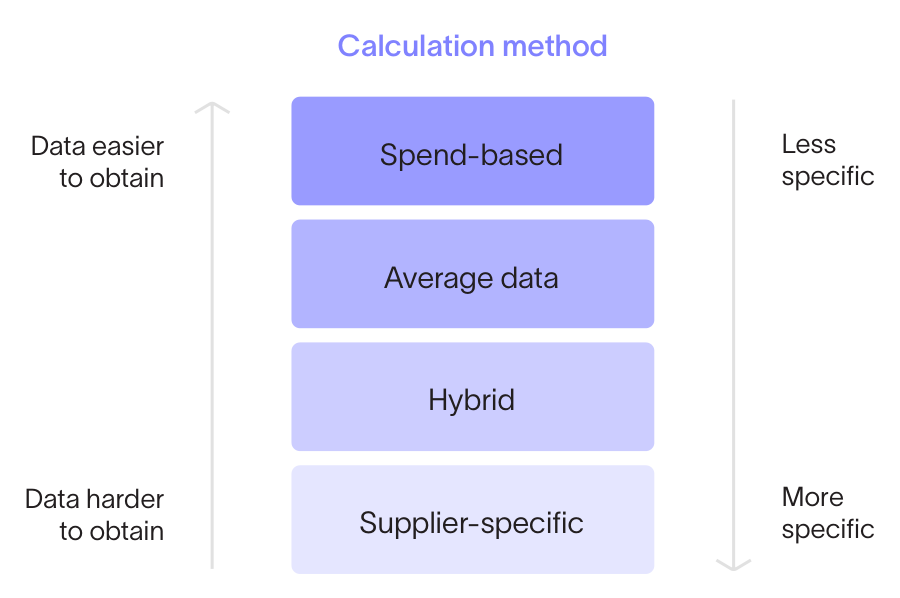
When choosing methods, follow the GHG Protocol’s data quality hierarchy: prioritise direct measurements or supplier-specific data, and use generic proxies only where necessary. Be consistent: apply the same method to similar sources unless there is a good reason not to.
For example, you might determine that Scope 3 Category 1 (Purchased Goods) for packaging materials is calculated using supplier-specific emission factors from your company’s main packaging supplier, covering 80% of spend in that category. The remaining 20% of miscellaneous purchases are then estimated using a spend-based factor.
The calculation stage requires detailed alignment with the Greenhouse Gas (GHG) Protocol. The Protocol provides detailed guidance on each category. Reviewing and understanding the relevant sections, and any industry-specific guidance is important to ensuring your company adopts an appropriate approach. For complex areas like product use-phase or investment emissions, it may be appropriate to seek subject matter expertise from external advisors.
Step 4:Data Collection – Gathering Primary and Secondary Data
With methods defined, the work of data collection begins. This step is about sourcing the actual input data to feed into the calculation formulas. Data for Scope 3 will come in two broad forms:
Primary Data
This is specific data from your company’s own operations or value chain partners. Examples of these could include:
- actual quantity of each material purchased
- fuel use data provided by a logistics provider
- emissions reports from suppliers, records of business travel miles from the company’s travel booking system, etc.
Primary data is ideally measured or reported by the source (e.g. a supplier measures its energy use and provides the associated emissions for the products purchased by your company). As more companies begin to disclose emissions data under the new reporting regime, organisations can increasingly draw on publicly available, company-specific information. Over time, this growing disclosure landscape will make it easier to incorporate supplier data into Scope 3 assessments in a more automated and systematic way.
Secondary Data
This includes industry-average factors, databases, literature values, or assumptions used when primary data is not available. Examples include:
- emission factors from databases (like kg CO2 per dollar of spend in sector X, or kg CO2 per tonne of steel produced on average)
- generic datasets (such as average energy consumption of an appliance).
In practice, both primary and secondary data will be used together to build the inventory. Focus first on getting primary data for your company’s biggest categories and suppliers, using questionnaires, system extracts, or supplier platforms. Fill gaps with secondary data, aiming to replace it with better data over time.
A good way to manage data collection is with a plan linked to the company’s screening results and materiality assessment. Focus first on the suppliers and categories that contribute most. Strong and early collaboration between procurement and sustainability teams can be a huge advantage. Procurement team members are often best placed to effectively leverage supplier connections to gather information. Sustainability team members can play a guidance and monitoring role that focuses on the preferable data types being identified and requested. Try to ensure that all data is collected in a consistent format and is well-documented, including units, assumptions, and any calculations.
Data collection is often the most time-consuming part of building a Scope 3 inventory, especially with large supplier bases. This is why starting early matters. Attaining anything even approaching 100% primary data rates in the first reporting cycle may be completely unrealistic. A more pragmatic and productive approach may be to focus on getting your company’s carbon data pipeline flowing well. Concentrate, at least initially, on the most readily accessible data. Supplementation with informed estimates and derivative analysis is likely to play an important role in the early years too. Another foundational focus area is the establishment of systems and external partnerships to improve the collection of better-quality (and quantity) data going forward.
Many organisations will find they are able to expand the boundary of primary data year on year, for example, moving from 50% of spend covered by supplier-specific data in year one to 70% in year two, and so on.
There is now a range of technological solutions to assist with, and greatly enhance, the value of data collection and analysis. The more companies can automate, streamline and enhance data collection processes as part of business-as-usual processes, the less the likely pressure of annual scrambling to meet statutory reporting deadlines.
Step 5:Refinement and Iteration – Improving Accuracy Over Time Data
The final step is not an endpoint, but rather an ongoing process of refinement. After completing the first Scope 3 inventory, review the results critically: Where are the biggest uncertainties? Which categories drive most emissions, and what is the level of confidence in the numbers? Simple checks, like comparing emissions per dollar of spend, can help spot anomalies.
Refinement means steadily improving:
- Data quality: Replace estimates with better data each cycle. For example, move from industry averages to supplier-specific emission factors, or swap generic commuting assumptions for an employee survey.
- Scope: Start with top categories (e.g. the five that cover 90% of emissions), then expand to smaller suppliers or additional categories over time to move to a more complete inventory.
- Methods: Stay tuned to updates in standards or best practices. If new calculation tools or emission factor databases that improve accuracy become available, consider adopting them. Aim for consistency and transparency. If there are changes or variations in methodology, make sure these are properly documented and justified.
- Cross-functional integration: As climate reporting matures within your company, the finance team, risk team, and others may get more involved. Integrating Scope 3 data with financial systems or risk assessment tools could improve accuracy, for instance, tying emissions factors to exact spend categories in accounting ledgers.
- Verification and assurance feedback: During the assurance process, auditors may identify areas where data quality can be improved or where stronger controls are needed. This feedback should be used to refine and strengthen processes for the next reporting cycle. Some organisations choose to seek limited assurance ahead of mandatory timelines, gaining early insights that help build robust systems before assurance becomes a legislative requirement.
Scope 3 inventory-building might be most appropriately viewed as an ongoing, multi-year process of continuous improvement. Companies should be positioning and preparing to develop and refine data over time, with corresponding improvements in the reliability of disclosures with each passing year. In Australia, the present indications are that fourth-year disclosures will need to be sufficiently robust to withstand reasonable assurance auditing. Use the early years to build capacity and refine.
Conclusion
With Australia’s climate reporting regime now in force, the time to act is now. The key is to start early, build a cross-functional team, and use available tools and data to get started. The goal of the first year’s inventory might be best understood as building a solid foundation for steady improvement and refinement across subsequent reporting periods.
Effectively measuring Scope 3 will become a necessary corporate skill for demonstrating full compliance with longer-term regulatory expectations. It will also be essential to attaining core ESG outcomes, including demonstrating effective management of climate-related risk in a company’s value chain.
Scope 3 calculations may be complex, but this should not be viewed as an insurmountable challenge. Once a company knows where its emissions are most concentrated, more effective management strategies can be implemented. Gaining clearer insights into where your company’s Scope 3 emissions are most concentrated is vital in understanding which suppliers, categories, or life-cycle stages should be the focal point(s) in ongoing carbon footprint reduction efforts. That might mean working with suppliers on low-carbon materials, redesigning products for efficiency, or setting and tracking science-based targets.
The ongoing process of building a comprehensive scope 3 inventory can be a powerful tool for positive collaboration and action.
Simplify Scope 3 Reporting with Fair Supply
Fair Supply’s tool enables companies to put procurement spend data to quickly identify emissions hotspots across suppliers and categories, in line with GHG Protocol guidance. This provides a clear map of where to focus, without needing detailed supplier data upfront.
The result is a practical and efficient foundation to cut through data complexity and pursue deeper analysis and action.
Notes
- CDP Supply Chain Report: Changing the Chain, 2019: CDP Climate Change Questionnaire April 2022. ↩
- Certain exceptions apply. For example, entities already reporting under the National Greenhouse and Energy Reporting (NGER) Act may continue to measure Scope 1 and 2 emissions in line with NGER requirements. ↩
- Auditing and Assurance Standards Board (AUASB), Climate and Sustainability Assurance Requirements Approved (January 2025). ↩
- For further detail, see Section E of ASIC Regulatory Guide 280 Sustainability reporting (RG 280) (March 2025). ↩
- World Resources Institute (WRI) and World Business Council for Sustainable Development (WBCSD), Corporate Value Chain (Scope 3) Accounting and Reporting Standard (2011), [p.17]. ↩
- World Resources Institute (WRI) and World Business Council for Sustainable Development (WBCSD), Corporate Value Chain (Scope 3) Accounting and Reporting Standard (2011), [pg 85]. ↩
- World Resources Institute (WRI) and World Business Council for Sustainable Development (WBCSD), Corporate Value Chain (Scope 3) Accounting and Reporting Standard (2011), [pg 11]. ↩
The material and the analysis here have been prepared solely for this report and for no other purpose. This is prepared by Fair Supply Analytics Pty Limited ACN 637 115 587 (Fair Supply). Fair Supply is not a financial or legal adviser and we have not considered any accounting, commercial, technical, operational, tax or financial matters.
Fair Supply is not able to confirm the reliability, accuracy, or completeness of the information (including, but not limited to, information provided by third parties and publicly available information). Fair Supply makes no representation or warranty, express or implied that such information is accurate or complete.
Fair Supply, its officers, employees and agents are not liable to you for any indirect, incidental, special or consequential loss or damage, loss of profits or anticipated profits, economic loss, loss of business opportunity, loss of data, loss of reputation or loss of revenue (irrespective of whether the loss or damage is caused by or relates to breach of contract, tort (including negligence), statute or otherwise) arising out of or in connection with the material or all links in the presentation, including (but not limited to) for any person placing any reliance on, or acting on the basis of the material content.