
ESG Software for Financial Services and Superannuation Companies
Fair Supply enables financial institutions and superannuation funds to quantify ESG exposure across both investment portfolios and organisational supply chains, using defensible data that supports strategic decision-making, regulatory alignment and value creation.
.avif)
Leading financial institutions use Fair Supply to strengthen governance, improve portfolio resilience and identify opportunities for sustainable growth.







Accelerate responsible investment and meet evolving compliance expectations
Rather than treating compliance as a checkbox exercise, forward-thinking financial services and superannuation organisations are using ESG insights to inform capital allocation, strengthen governance, and demonstrate responsible stewardship to members, clients and regulators.
Fair Supply turns this complexity into clarity, enabling ESG, sustainability and risk teams to make more informed investment and organisational decision-making
Stay ahead of regulation
Banks and financial service organisations need to keep pace with rapidly evolving ESG compliance requirements across modern slavery, sustainability and nature reporting. frameworks. Fair Supply supports alignment with ISSB, TCFD, CSRD, ASRS, CSDDD and various global modern slavery legislation by consolidating company-level insights from investment portfolios and supply chains into transparent, audit-ready outputs.
Build investor and stakeholder trust
Showcase your commitment to responsible investment and ethical operations with credible, data-driven insights that withstand scrutiny from analysts, boards, regulators and members.
Identify opportunities for sustainable finance and responsible investment
Fair Supply helps institutions advance responsible investment by moving beyond risk identification to understanding where ESG performance can drive long-term value. Use portfolio-level insights to inform credit and investment decisions, support stewardship, and underpin sustainable finance products. These insights also help track progress against decarbonisation and nature-related targets, enabling more informed capital allocation and strengthening client and member value.
Manage multiple risk types, all in one platform

Modern Slavery
Understand human rights risks and stay aligned with current and emerging regulations in any region.

Carbon Emissions
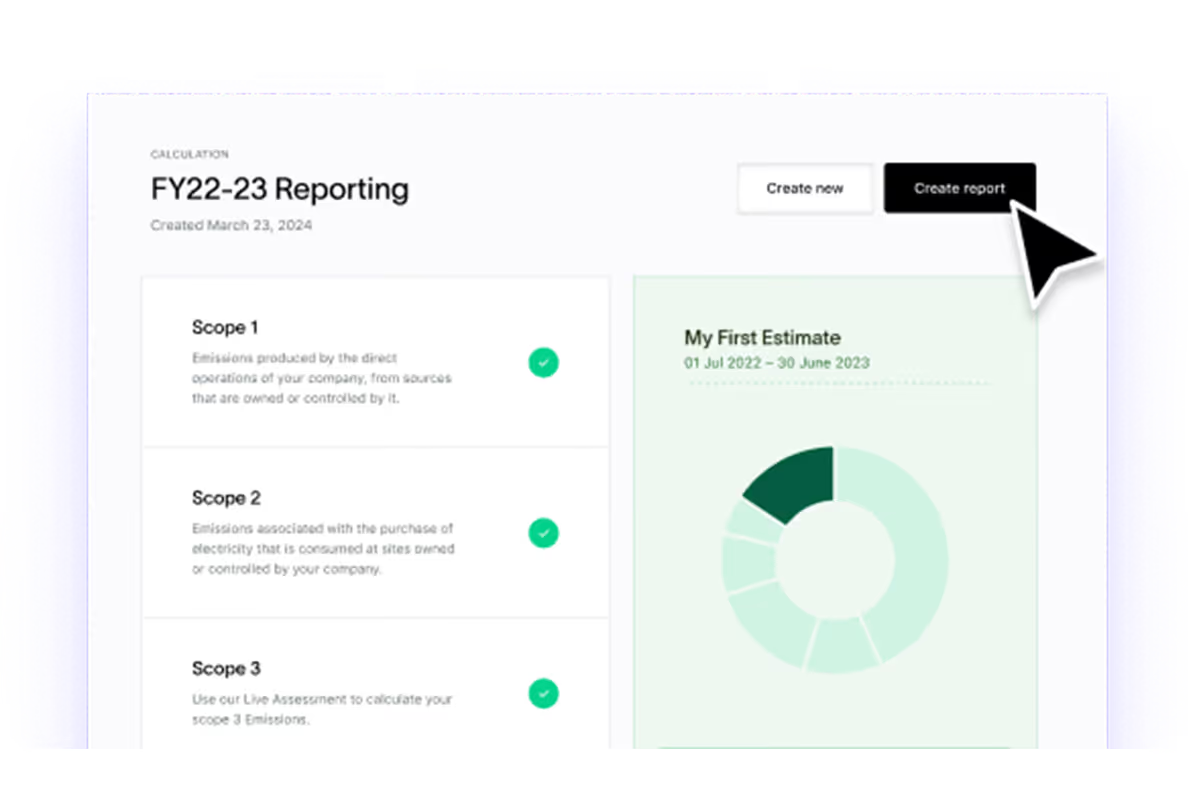
Model Scope 1, 2 and 3 emissions across your supply chain and produce fast disclosures and regulator-ready reports.

Biodiversity Impact
Measure environmental destruction throughout your supply chain and proactively reduce your impact to stay ahead of evolving regulations and customer concerns.

Global Trade Risk
Use our tariff calculator to understand the impact of global trade policy shifts on your supply chain costs.
Capabilities for Financial Services
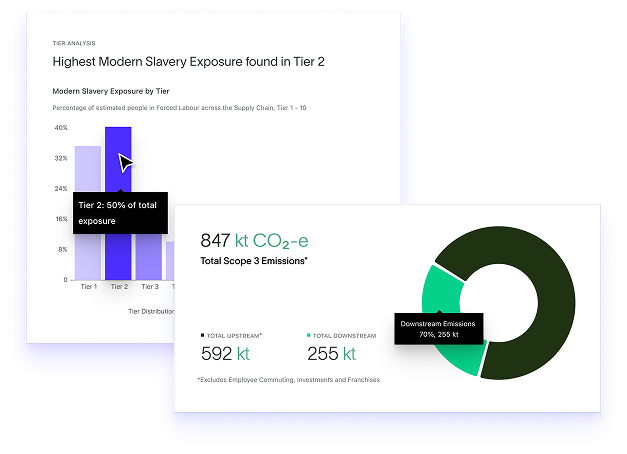
Map your value chain with MRIO modelling that identifies indirect ESG and operational risks across more than ten tiers.
Portfolio ESG Screening
Assess ESG exposure across equity, fixed income and other asset classes. Fair Supply quantifies modern slavery, emissions and biodiversity risks within investee value chains to support regulatory reporting and responsible investment.
Financed Emissions and Scope 3 Screening
Support credible climate disclosures by modelling Scope 3 financed emissions and supplier-related emissions using transparent classifications and emissions factors. Outputs align with ISSB, ASRS and TCFD.
Company ESG and Third-Party Due Diligence
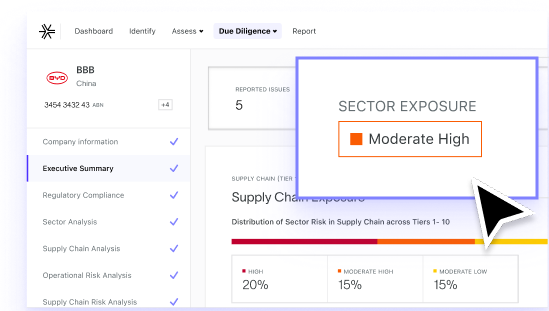
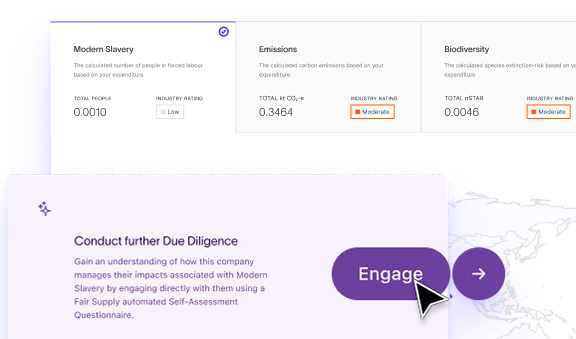
Strengthen oversight of internal suppliers and ESG-exposed companies in investment and lending portfolios. Fair Supply’s Self-Assessment Questionnaires on modern slavery, emissions and biodiversity are automatically scored and integrated into company risk profiles and audit records.
Engage Suppliers at Scale
Centralise how you assess, engage, and document supplier ESG performance. Standardise SAQs, track responses, and maintain a clear, auditable record of activity.





Companies like yours are getting visibility into their risks
FAQs
Why do financial services and superannuation organisations need ESG software?
Financial institutions and superannuation organisations face significant ESG expectations due to regulatory obligations, fiduciary duties and stakeholder scrutiny. Fair Supply’s ESG software helps quantify organisational and supply chain risks consistently, covering modern slavery, emissions, biodiversity and trade exposure. Fair Supply’s ESG software uses defensible data and transparent methodologies suited to financial governance environments that require strong governance and auditability.
How does ESG software improve real-world usability for operational, risk and procurement teams in financial services?
Financial services organisations manage large supplier ecosystems with limited internal data capacity. Fair Supply requires only supplier name and spend to begin to generate multi-tier risk insights immediately. Dashboards then translate complex modelling into actionable summaries that support internal assurance, executive reporting, risk assessments and regulatory submissions.
How does Fair Supply support reporting and compliance for financial services and superannuation?
Modern slavery, climate and sustainability reporting obligations continue to expand across CSRD, CSDDD, TCFD, ISSB and industry-specific standards. Fair Supply consolidates supplier-level risk data into audit-ready, regulator-aligned reporting outputs. Financial institutions can benefit from a single system of record across ESG domains, business units and reporting cycles.
How does Fair Supply support Tier 10 visibility for financial service organisations
Fair Supply maps risk through 10 tiers of the supply chains of both portfolio companies and direct suppliers. This illuminates indirect exposure across global service, technology and operational networks that cannot be seen through supplier self-reporting alone.
How does ESG software enhance supplier due diligence in the financial sector?
Financial institutions rely heavily on third-party services, where due diligence is essential for regulatory and operational risk management. Fair Supply streamlines assessments using standardised, configurable Self-Assessment Questionnaires covering modern slavery, emissions and biodiversity. Responses feed into supplier risk profiles and create an auditable record for internal risk committees, trustees and regulators.
How does Fair Supply help financial institutions assess biodiversity-related risks?
While financial services organisations may have fewer direct ecological impacts, biodiversity risk emerges through upstream service and technology supply chains. Fair Supply uses nSTAR methodology and global datasets (IUCN, IBAT) to quantify supplier-specific biodiversity exposure, supporting alignment with TNFD, ISSB and CSRD nature-related disclosure requirements.
What makes Fair Supply’s data defensible for financial services audits and regulatory reviews?
Financial institutions operate under heightened regulatory scrutiny and fiduciary obligations, requiring ESG data that is traceable, consistent and aligned with mandated frameworks. Fair Supply applies methodologies that are required or recognised under regulatory frameworks (such as the GHG Protocol), and draws on globally validated datasets.
Fair Supply automatically produces consistent, repeatable outputs with transparent audit trails, enabling organisations to evidence how data has been classified, modelled and applied. This supports internal audit processes, board and investment governance reporting without requiring separate manual reconstruction of methodologies or assumptions.