
ESG Software for Infrastructure Companies
Fair Supply enables infrastructure organisations to map complex project and procurement supply chains, quantify ESG risks across construction, civil works and asset operations, and take faster, more defensible action.
.avif)
Major infrastructure developers, contractors and operators around the world trust Fair Supply to protect their supply chains and strengthen ESG performance.










Turn ESG obligations into a strategic advantage
Infrastructure procurement teams must source global equipment, manage construction contractors across multiple sites, and maintain critical operational assets. All while regulators demand full ESG compliance and boards expect continuity of essential services.
Fair Supply turns this complexity into clarity, enabling project, procurement and sustainability teams to screen risks instantly and act with confidence.
With Fair Supply, ESG becomes a practical enabler for better project and commercial decisions, not a disconnected compliance task.
Stay ahead of regulation
Remain audit-ready across the jurisdictions where you build, operate and procure with one platform designed for compliance confidence. Infrastructure organisations face fast-evolving obligations across forced labour, climate, emissions and sustainability reporting. Fair Supply helps you keep pace with frameworks such as ISSB, TCFD, CSRD, CSDDD, modern slavery legislation and NGER obligations.
Build investor and stakeholder trust
Demonstrate responsible infrastructure delivery with defensible, independently assured insights that withstand scrutiny from governments, regulators, investors, communities and project partners.
Uncover hidden risks in your supply chain
The most significant ESG risks aren’t at Tier 1, they sit deep within global materials, construction, engineering and critical equipment supply chains. Fair Supply exposes these risks before they become operational, reputational or regulatory liabilities.
Manage multiple risk types, all in one platform

Modern Slavery
Understand human rights risks and stay aligned with current and emerging regulations in any region.

Carbon Emissions
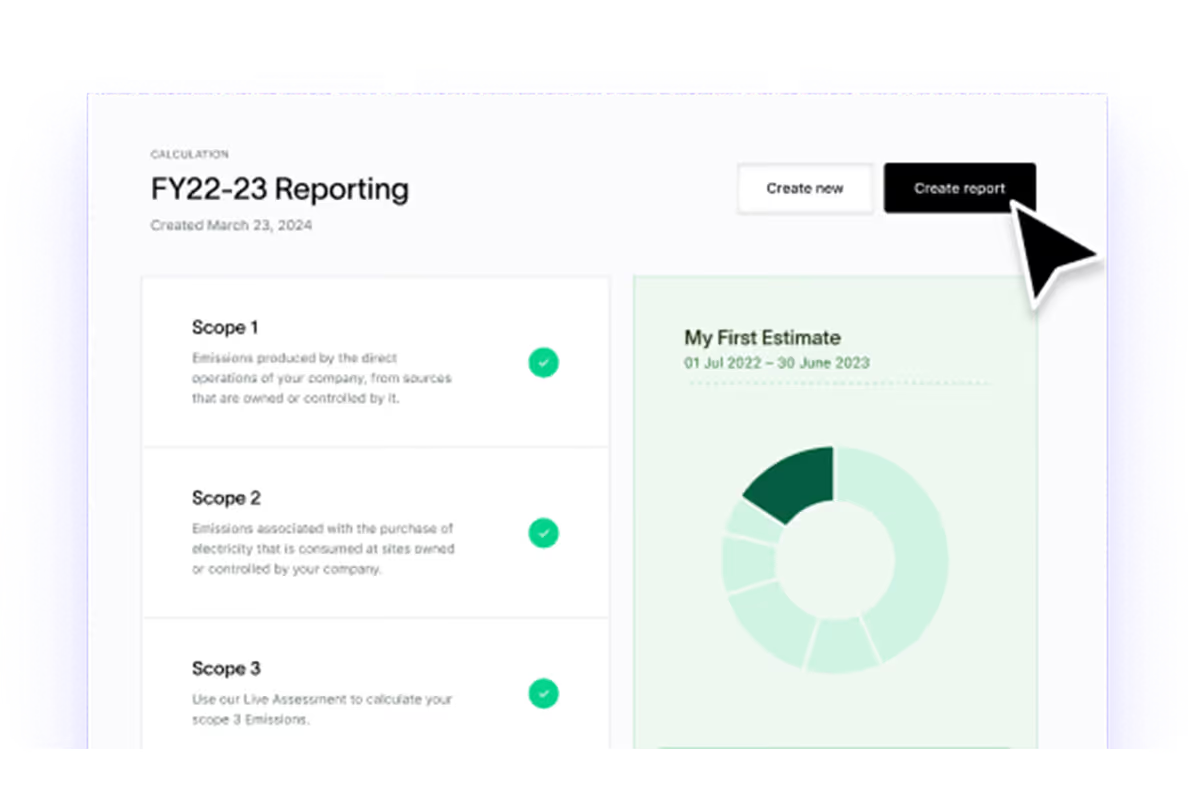
Model Scope 1, 2 and 3 emissions across your supply chain and produce fast disclosures and regulator-ready reports.

Biodiversity Impact
Measure environmental destruction throughout your supply chain and proactively reduce your impact to stay ahead of evolving regulations and customer concerns.

Global Trade Risk
Use our tariff calculator to understand the impact of global trade policy shifts on your supply chain costs.
Global Supply Chain Mapping
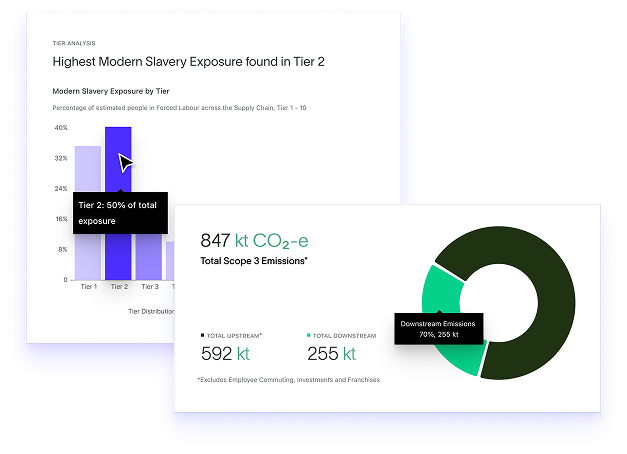
Visualise every tier of your infrastructure supply chain with high-resolution modelling that reveals ESG and operational risks across large, multi-contractor project environments. Fair Supply provides objective risk assessment without defaulting to supplier self-reporting, highlighting exposures across steel, concrete, aggregates, electrical components, engineering services, specialist trades and construction activities.
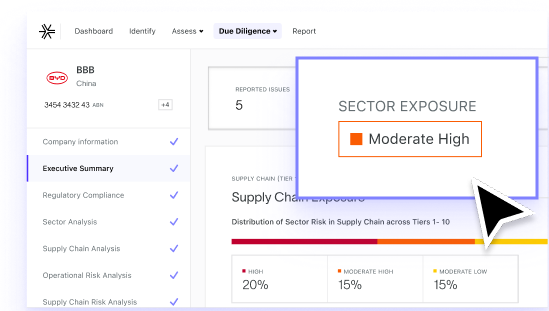
Once risks are identified, the platform guides targeted supplier engagement through adaptive, risk-based questionnaires. Infrastructure procurement teams can screen new contractors in seconds, without waiting for sustainability sign-off or relying on external consultants.
Engage Suppliers at Scale
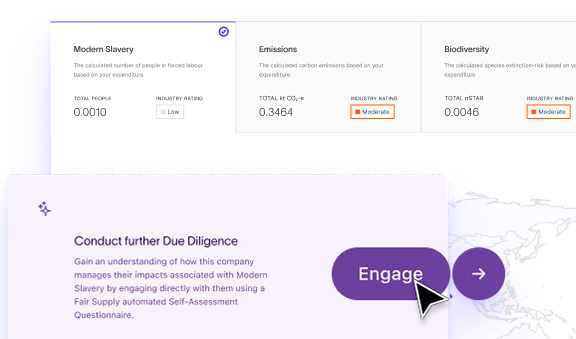
Centralise how you assess, engage, and document supplier ESG performance. Standardise SAQs, track responses, and maintain a clear, auditable record of activity.



Companies like yours are getting visibility into their risks
FAQs
Don't see what you're looking for?
Why do infrastructure organisations need ESG software?
Infrastructure projects rely on complex, multi-layered supply chains with significant exposure to ESG issues - from modern slavery in materials and equipment manufacturing to emissions across construction and operations. ESG software enables consistent, defensible quantification of these risks across all suppliers and procurement categories, as well as ensuring compliance with ISSB, CSRD, TCFD, Australian Modern Slavery legislation, Canadian Modern Slavery legislation, and critical minerals frameworks. All while delivering consistent, defensible disclosures to investors and regulators.
How does Fair Supply support Tier 10 visibility for infrastructure supply chains?
Infrastructure delivery involves extensive subcontracting and global materials sourcing. Fair Supply maps ESG risk across up to 10 tiers using proprietary multi-regional input–output (MRIO) modelling and economic intelligence, exposing upstream issues that contractor self-reporting cannot identify. This includes visibility into deep-tier materials manufacturing, engineering inputs, construction services and civil works supply chains.
How does ESG software improve real-world usability for procurement and project teams?
Infrastructure procurement teams manage thousands of suppliers under tight timelines. Fair Supply requires only supplier name and spend to generate multi-tier risk insights with no complex data preparation needed. Dashboards translate the modelling outputs into actionable insights that support best practice procurement - all in one platform.
How does Fair Supply support infrastructure ESG reporting and compliance?
Infrastructure owners and contractors face stringent reporting obligations across modern slavery, climate and sustainability frameworks such as CSRD, CSDDD, TCFD and ISSB. Fair Supply produces audit-ready ESG reports aligned with these standards using supplier-level risk data. This centralised approach provides a single source of truth for ESG reporting across projects, business units and reporting cycles - all into one tool.
How does Fair Supply support Scope 3 emissions screening for infrastructure projects?
Scope 3 emissions are extensive in infrastructure projects. From materials manufacturing to construction processes, equipment and logistics. Fair Supply automates Scope 3 screening through spend classification, defensible emissions factors and reporting-ready summaries. This allows infrastructure organisations to identify high-impact categories early and integrate findings into decarbonisation strategies and project design.
How does ESG software enhance supplier due diligence for construction and infrastructure?
Infrastructure delivery relies heavily on subcontractors, skilled trades and complex contractor networks. Fair Supply standardises due diligence with configurable SAQs covering modern slavery, emissions and biodiversity. Supplier responses feed directly into risk scoring and create an auditable record for client requirements, internal assurance, tender evaluation and regulatory compliance.
How does Fair Supply help infrastructure companies assess biodiversity-related risks?
Infrastructure projects can drive biodiversity impacts both directly and through material supply chains. Fair Supply provides supplier-specific biodiversity risk scoring using nSTAR methodology and datasets such as IUCN Red List and IBAT. This supports TNFD-aligned reporting and highlights where upstream and contractor-driven biodiversity risks are concentrated.
What makes Fair Supply’s data defensible for infrastructure-sector audits and project governance?
Fair Supply uses independently assured methodologies, globally validated datasets and full audit trails to generate consistent, defensible ESG insights. Each assessment aligns with leading ESG frameworks, enabling reliable decision-making for procurement panels, governance groups, financiers and regulators.
Does Fair Supply offer consulting and advisory services?
Yes. Alongside our supply chain ESG intelligence platform, we provide specialist advisory across two core regulatory domains: modern slavery reporting consulting for organisations meeting their obligations under the Modern Slavery Act 2018 (Cth), and climate reporting consulting for entities preparing climate-related financial disclosures. Our team maintains current knowledge of IFRS S2 (ISSB), EU CSRD, AASB S2, NZ CS 1 and other emerging frameworks to ensure comprehensive compliance guidance. Engagements range from one-off statement and disclosure preparation through to ongoing advisory retainers, and can be combined with platform access under a single agreement.
Does Fair Supply cover Scope 1 and 2 emissions as well as Scope 3?
Yes. Alongside our Scope 3 value chain modelling, the platform supports Scope 1 and 2 emissions reporting — covering direct emissions from owned or controlled sources and indirect emissions from purchased electricity, steam, heating and cooling. This gives organisations a single consolidated view across all three scopes for AASB S2, IFRS S2, and GHG Protocol-aligned disclosure, with outputs that integrate with existing carbon accounting platforms where required.